Open Play in Age of Sigmar: weird twists, wild objectives, and one terrible hobby joke
We recently fell into one of those classic hobby rabbit holes: starting from a single odd rule, and ending up excitedly discussing whole ways of playing that we had somehow not paid enough attention to before.
This time the topic was Age of Sigmar Open Play — and honestly, the more we talked about it, the more it sounded like a fantastic playground for people who want big, cinematic battles without being too constrained by formal structure.
The rule that started it
Michal dropped this battlefield twist into chat:
Flying units have their move characteristics halved in one random quadrant of the battlefield each battle round (roll a D4 for the quadrant).
And yes, our first reaction was basically: that is a good twist.
It is exactly the kind of rule that immediately paints a picture in our heads. Some weird magical turbulence, cursed winds, unstable aether currents — whatever the explanation, it makes the battlefield feel alive. It is also just the right level of chaos: not so much that the game becomes nonsense, but enough that you suddenly have to care about where your flying units are going.
Then, naturally, the conversation derailed
Because no good rules discussion survives long without at least one terrible joke.
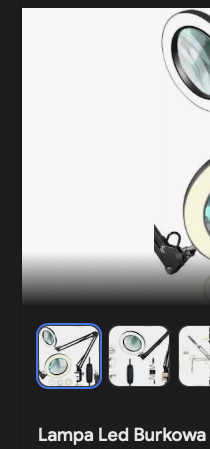
Dubry came in with a modelling riddle about what you would call a hobby magnifier belonging to an ordinary, non-pedigree dog. A proper groaner. The kind of joke that makes the room go quiet for half a second and then everyone starts laughing despite themselves.
Michal’s verdict was that Sergey Burkov would be proud — apparently a famous Soviet modeller, and definitely not to be confused with Biurkov.
We refuse to explain the joke further. If you get it, you get it. If not, maybe that is for the best.
Open Play gets really interesting when you look at the objectives
The second thing that caught our attention was one of the possible victory conditions:
The first player to destroy an enemy unit gains immediate victory. If no unit is destroyed by the end of the game, it’s a draw.
Our immediate reaction was also immediate suspicion.
Because yes — that sounds dramatic, but it also sounds like a huge advantage for shooting armies. If all you need is to pick off one unit before the other player can do the same, ranged damage starts looking very, very attractive. So while it is memorable, it did not strike us as the smartest objective in the world.
And that was the moment where the wider Open Play conversation really kicked off.
Wait, “battle” in AoS works like this?
Part of the fun here was simply rediscovering how flexible Age of Sigmar can be outside its more structured formats.
Michal pointed out that what we loosely called “battle” does not really exist in the same way as a single defined format in AoS. Instead, there is Open Play, and the core book apparently includes rules aimed at people who want big, epic battles in the spirit of old-school Warhammer Fantasy.
That is a genuinely cool idea.
There is something refreshing about a rules section that more or less tells players: talk to each other, agree what kind of game you want, decide on the victory condition, and even decide whether you want to roll for a twist at all.
That kind of framework feels very hobby-friendly. Less like solving a tournament packet, more like setting up a memorable evening.
You can really make the game your own
The more examples we looked at, the more Open Play started sounding like a toolbox rather than a rigid mode.
Another objective that came up was this:
Each player nominates one of their heroes at the start of the game. The player whose chosen hero slays the most enemy models wins.
That one is immediately more characterful. It tells a story before the first dice are even rolled. You are not just trying to score points — you are backing a champion and seeing whether they become the legend of the battle.
And then there is the really open-ended part:
In open play, there are no restrictions on which models you can include in your army or whether the units in your army must belong to a single faction - all you need to do is agree with your opponent on the points limit for the game.
That is the kind of rule that can either produce glorious narrative nonsense or complete madness, depending on the group — which is honestly part of the appeal.
It also got us thinking about asymmetrical scenarios. Dubry immediately went to the fun question: what if one army starts as the defender, holding an area with 1000 points, while the attacker has 1500 and has to seize that ground within five turns?
And really, that is the heart of why Open Play sounds so good. Once you stop asking “what is the official matched objective?” and start asking “what would make for a cool battle?”, the possibilities open up fast.
Big battle energy
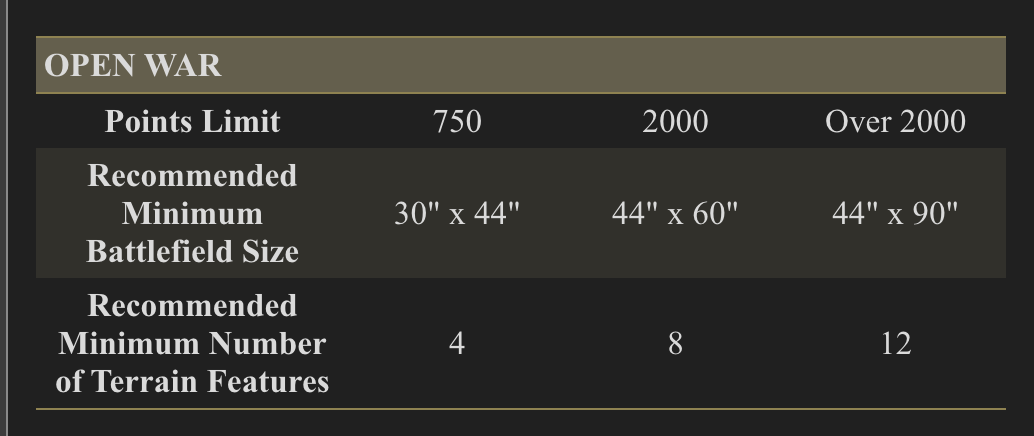
We also touched on the fact that some point levels would feel a bit odd for this style. A full-on battle at 750 points sounds slightly strange to us too. When we think “epic battle,” we instinctively imagine something with more room to breathe — more units, more board presence, more weird side stories happening at once.
That said, even at smaller sizes, the Open Play approach still feels useful. Not necessarily because every random objective will be perfect, but because it encourages the right mindset: agree what sounds fun, adjust what seems silly, and do not be afraid to build your own scenario.
Why we like this so much
What we took away from this chat is pretty simple:
- Open Play in Age of Sigmar seems much more interesting than we had assumed
- the twists can add great flavour
- some objectives are gloriously cinematic
- some objectives are probably nonsense and need a quick pre-game reality check
- and the whole thing seems built around players actually talking to each other and deciding what kind of game they want
Honestly, that last point may be the best one.
Not every game needs to be perfectly balanced and tournament-clean. Sometimes we just want magical weather, a ridiculous hero challenge, a lopsided siege setup, and a battlefield story we will still be talking about afterwards.
And apparently, AoS Open Play is very ready to support exactly that.
If nothing else, this conversation definitely pushed us toward finally reading those rules properly instead of just vaguely assuming we knew what was in there.
Which, in this hobby, is often how the best ideas begin.