Spearhead Looks Better the More We Learn It
We had one of those very relatable hobby chats recently: first a battle report, then rules talk, and five minutes later we were already looking at boxes and wondering whether we were about to buy another army.
Dubry dropped a video where his “own” two Spearheads fought each other, and honestly that alone was enough to get us talking. What stood out immediately was something we really like in small-format games: the result apparently stayed uncertain until the last turn. That is a huge plus for us. There is nothing worse than a game that feels decided too early, and Spearhead seems to avoid that pretty well.
The more we look at it, the more playable it seems
Our first impression from the discussion was simple: if both players have a decent handle on the rules, Spearhead looks very playable. Not just as a stripped-down introduction to Age of Sigmar, but as a format that can genuinely stand on its own.
A big part of that seems to be how scoring works.
At first we were talking past each other a bit, but the final version was this:
- there are objectives that exist as part of the game,
- there are twists,
- and there are also card-based tasks/commands that your opponent does not fully know.
Michał clarified that each turn you have your own command, and you can either use it as an order or complete the task for victory points. The important bit is that the tasks on your card are hidden from your opponent, even if the general structure of scoring in the scenario is not.
And honestly, we really like that idea.
Hidden scoring adds tension
This is probably the most exciting thing from the whole conversation. Hidden scoring creates that nice uncertainty where you can read the board state, but you still cannot be completely sure what the other player is trying to squeeze out of the turn.
That makes the game feel more alive.
You are not just calculating visible points on the table. You also have to think about what the other side might be setting up. Combined with twists and scenario objectives, that sounds like a very solid recipe for games that stay interesting until the end.
If that battle report is representative, Spearhead may have hit a really nice middle ground between accessibility and meaningful decision-making.
And then, inevitably, we started browsing boxes
Because of course we did.
At some point the conversation turned toward the Slaves to Darkness Spearhead, with the universal hobby meaning of posting a shop link followed by a question mark and a smiley. We all know what that means. It means somebody is already halfway to checkout.
At the same time, there was also a less enthusiastic reaction to one of the models shown in the discussion:
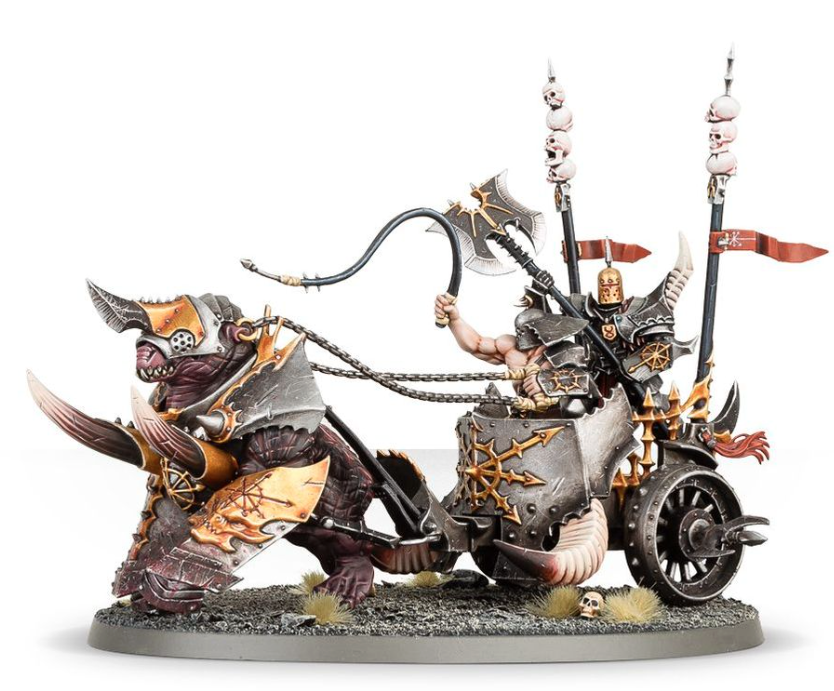
We are not going to pretend every model hits equally hard. Sometimes a unit makes us want to start a new project immediately, and sometimes the reaction is… a lot less charitable.
Push-fit, glue, and the eternal dream of skipping assembly
The other practical hobby question that came up was about the Stormcast paint set, specifically the Liberators inside it.
Dubry asked whether those miniatures also appear in other sets and whether they are always no-glue models. Michał’s answer was exactly the kind of thing that every Warhammer buyer has run into at some point: it depends.
The same unit can appear in different forms depending on the release:
- sometimes push-fit,
- sometimes requiring glue,
- and in this specific case, Michał noted that from the Skaventide-era releases onward, the currently sold versions should now be push-fit.
That is useful to know, especially for anyone treating Spearhead as a lower-friction way into Age of Sigmar. Assembly style matters more than people sometimes admit. If you want to get models on the table quickly, push-fit can make a real difference.
And yes, the most relatable line of the whole exchange may have been the wish that Games Workshop would simply sell them assembled and painted already. We suspect we are not alone in that dream.
Our takeaway
Right now our feeling is that Spearhead keeps sounding better the more we understand how it actually works.
What we like most from this chat:
- games seem capable of staying close until the final turn,
- hidden card objectives add tension,
- the format looks genuinely playable, not just introductory,
- and the model range still has enough hobby weirdness to spark the usual debates about boxes, sculpts, and assembly.
In other words: very Warhammer, and very promising.
If we keep talking about Spearhead at this rate, it is probably only a matter of time before more of us end up with suspiciously small Age of Sigmar armies on the shelf.