Why Chaos Knights Suddenly Made Us Want to Play Slaves to Darkness
Army-building notes after a very convincing first impression
Every now and then a unit gives us that immediate “oh no, this is the real deal” feeling. This time it was Chaos Knights in Slaves to Darkness.
Michał dropped a whole stream of impressions after getting games in, and honestly, it sounded less like “this unit is decent” and more like “why is everything in this army built like a truck?” If you’re thinking about an army-building direction for a future Age of Sigmar force, this is exactly the kind of faction feedback we love: not theoryhammer from a vacuum, but the vibe of actually putting models on the table.
Chaos Knights: the hammer unit that feels like a hammer
The headline was simple: Chaos Knights feel absolutely juiced on the charge.
According to Michał, they get:
- +1 rend on the charge
- +1 damage on the charge
- 3 attacks hitting on 3s
That already sounds nasty, but the important part is how that translated into the game. After the first charge, the opponent’s plan apparently shifted hard toward:
- getting away from the Knights,
- hiding behind terrain,
- and generally trying not to be where the Knights wanted to be.
That tells us a lot. A scary warscroll is one thing; a unit that changes the opponent’s movement plan is something else entirely.
With 10” move on a 30”x22” board, the Knights also seem fast enough that “just hide from them” isn’t a very reliable answer. If they can get into a reasonable charge position quickly, they create pressure just by existing.
Eye of the Gods and the snowball effect
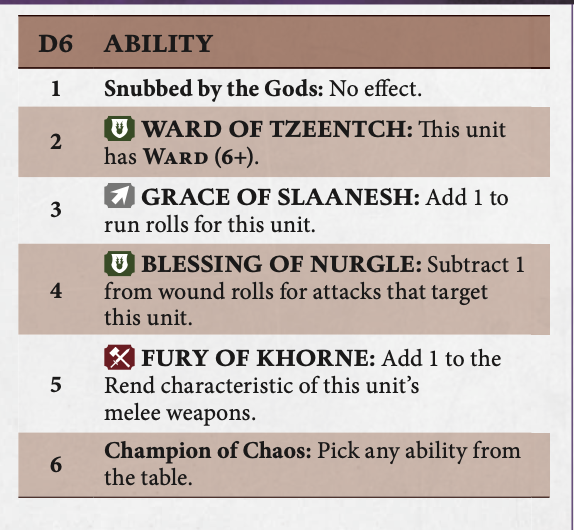
What really pushed this from “strong cavalry” into “this army feels powerful” territory was the faction battle trait: Eye of the Gods.
The way Michał described it, if a unit either:
- controls an objective, or
- destroys another unit that turn,
then you roll a D6 and the unit gets a buff.
That alone is already a nice reward engine for doing the things you want to do anyway. But then there’s another layer: the Chaos Lord has a spell that on a 2+ can grant Eye of the Gods to any unit.
That sounds huge for list construction, because it means you are not only rewarding your best-performing units — you can also accelerate the buff engine where you need it.
In Michał’s game, by around turn 4, basically the whole army had:
- 6+ ward
- +1 rend
And that’s the kind of cumulative scaling that makes an army feel like it’s tightening the screws every round. Not just one explosive unit, but a force that gets stronger as the game develops.
The contrast with Skaven was… dramatic
One of the funniest and most relatable parts of the conversation was the comparison to playing Skaven.
Michał described the Skaven experience as feeling like holding a disaster together with tape, where one crucial roll can decide whether you deliver a brutal hit or immediately get smashed yourself.
That probably resonates with anyone who has ever loved a fragile, chaotic army. With rats, the feel was:
- lots of 1 HP bodies,
- saves on 6s,
- and a lot riding on recursion and bringing units back.
With Slaves to Darkness, the feeling was the exact opposite: power. Real, straightforward, table-presence power.
That difference matters when you’re building an army. Not everyone wants their plan to feel like a controlled collapse. Sometimes you want to put down units that make the opponent rethink the entire board.
Other standouts: Chariot and Warriors
It wasn’t just the Knights.
Chaos Chariot
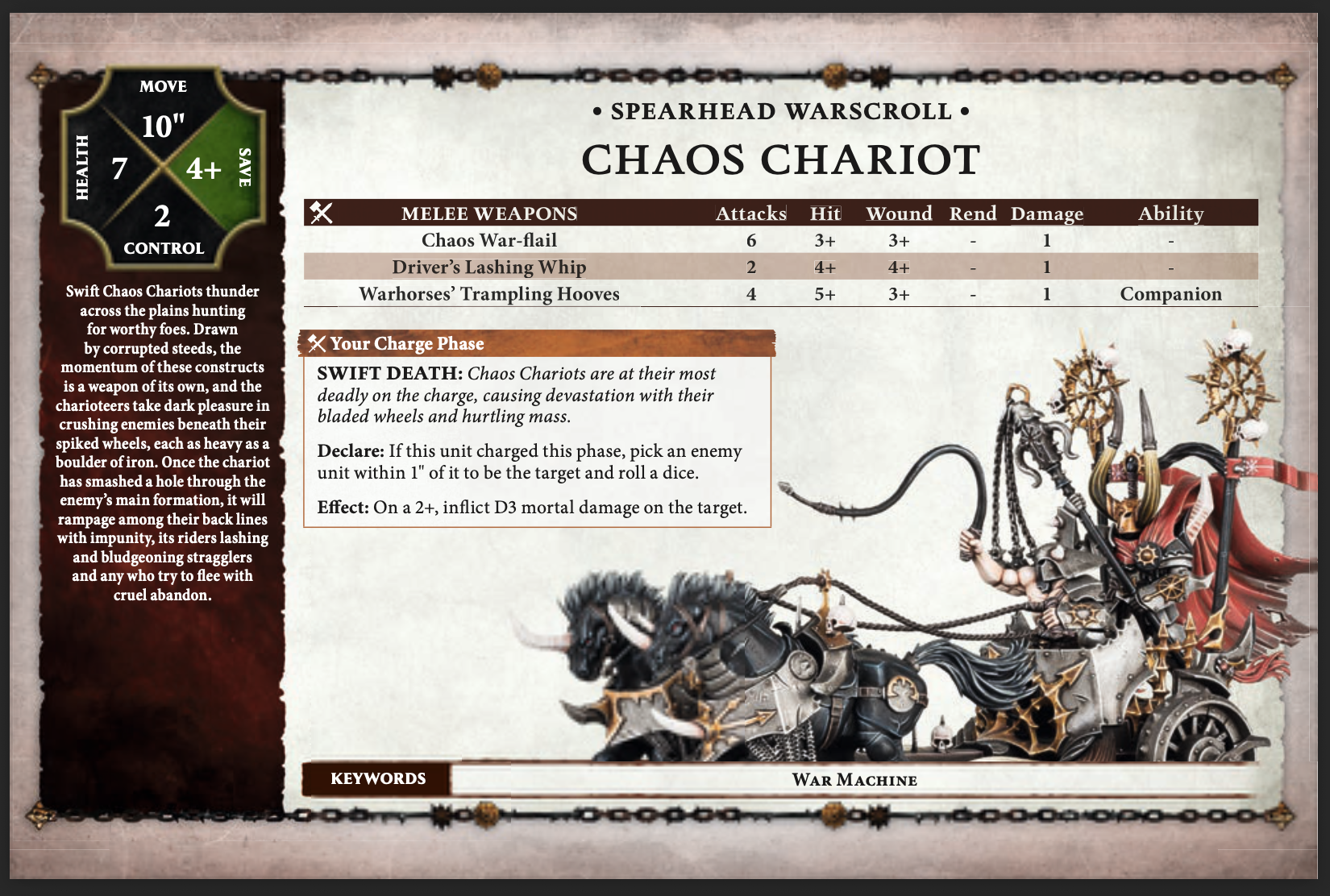
The Chariot also got a shoutout for being very solid on the charge:
- strong charge bonus,
- mortal wounds into the charged unit,
- but with the obvious downside of only 7 health.
That low durability helps explain why Michał pointed out its low points cost in “bigmar”. So from an army-building perspective, it sounds less like a centerpiece and more like a cheap pressure piece that can contribute impact damage and threaten flanks.
Chaos Warriors
Then there are the Warriors, who apparently get +1 to wound when attacking an objective they don’t control.
That’s a really nice rule for a unit that already wants to be grinding over the middle of the table. It gives them a clear battlefield role and makes them even better at flipping contested objectives.
So if we step back and look at the pieces together, the army starts to sketch itself out pretty naturally:
- Knights as the terrifying forward hammer,
- Warriors as objective-focused pressure infantry,
- Chaos Lord as a key support piece for buff acceleration,
- Chariot as a cheap charge threat.
The obvious weakness: it’s a melee army
Of course, it wasn’t all praise with no caveats. The big issue Michał called out was simple:
the army is basically melee.
That means if the opponent can control spacing, screen properly, or keep backing away while scoring, there is at least a theoretical way to make life difficult for Slaves to Darkness.
Ender immediately went to the obvious Kharadron Overlords angle: the key would probably be either:
- strategic repositioning (definitely not running away, obviously),
- or taking the charge in something like a Frigate setup with infantry screens.
So while the StD package sounds brutal once it connects, there is still a real gameplay question around delivery and matchups into armies that can avoid the fight or dictate engagement timing.
Our takeaway for army-building
The biggest thing we took from this chat is that Slaves to Darkness seem to offer a very clear and satisfying army identity right now.
They don’t sound fiddly. They don’t sound like they need ten layers of coping to function. They sound like an army that:
- moves up,
- threatens hard,
- rewards board control and kills,
- and gets stronger over time.
That’s a very appealing package if you’re planning a list for league play.
In fact, Michał was already saying that for the autumn league, he will probably play Slaves to Darkness. And based on this description, we get it.
Sometimes you don’t need a complicated sales pitch. Sometimes “after the first charge the opponent mostly wanted to escape and hide” is enough.
And honestly? That’s a pretty strong endorsement.