Battle Report: Plato, Paint Pots, and Our First Run of an AI-Written Skirmish
A very normal mission in ancient Greece
This week we played the first proper round of our own homemade skirmish system. And because apparently we like starting strong, the scenario was generated by AI and dropped us straight into one of the dumbest and most beautiful mission briefs we’ve seen in a while.
The setup was this: we had to travel to ancient Greece and deliver a brochure with the “final answer” to the chicken-and-egg problem to Plato, before rival INT agents from the Department of Historical Aesthetics could improve the Acropolis with explosives.
Yes, really.
The scenario title was “Precise Historical Correction”, with the operation subtitle “Chicken and Egg Paradox”, and honestly that already sold us on the whole thing.
The mission
The objective was simple on paper:
- get the note to Plato, or deliver it to the designated point in his Academy,
- survive long enough to get out,
- do it all within 6 rounds.
Opposing us were:
- Plato himself, trying to avoid trouble,
- Academy guards, protecting the philosopher and the objective,
- and the red-dice menace: the rival “Aesthetics” team.
There was also a chance of extra complications arriving mid-game, but the real star of the show was the overall tone: half espionage thriller, half absolute nonsense.
We had no minis, so Vallejo had to answer the call
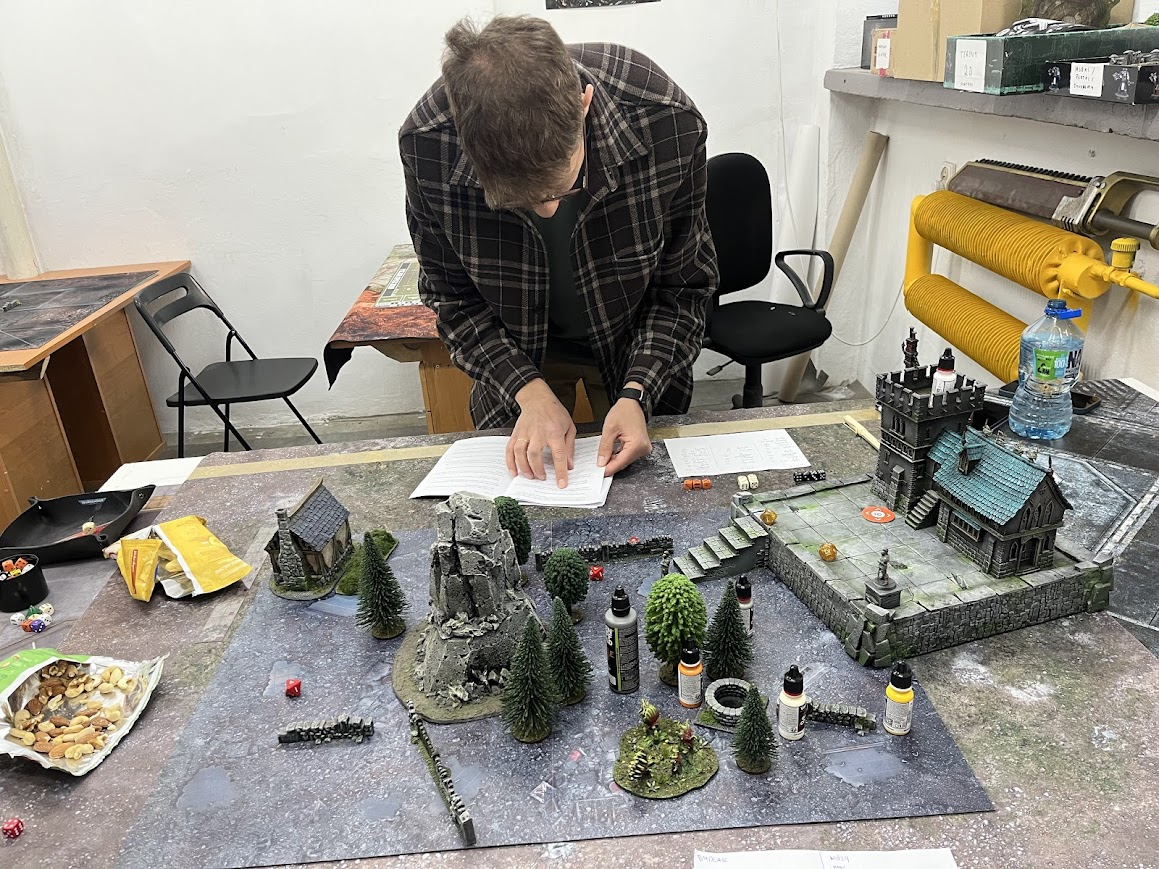
We didn’t have terrain or models ready for this one, so we did what every sensible hobby group does in a crisis: we played with Vallejo paint bottles and dice.
And honestly? It worked surprisingly well.
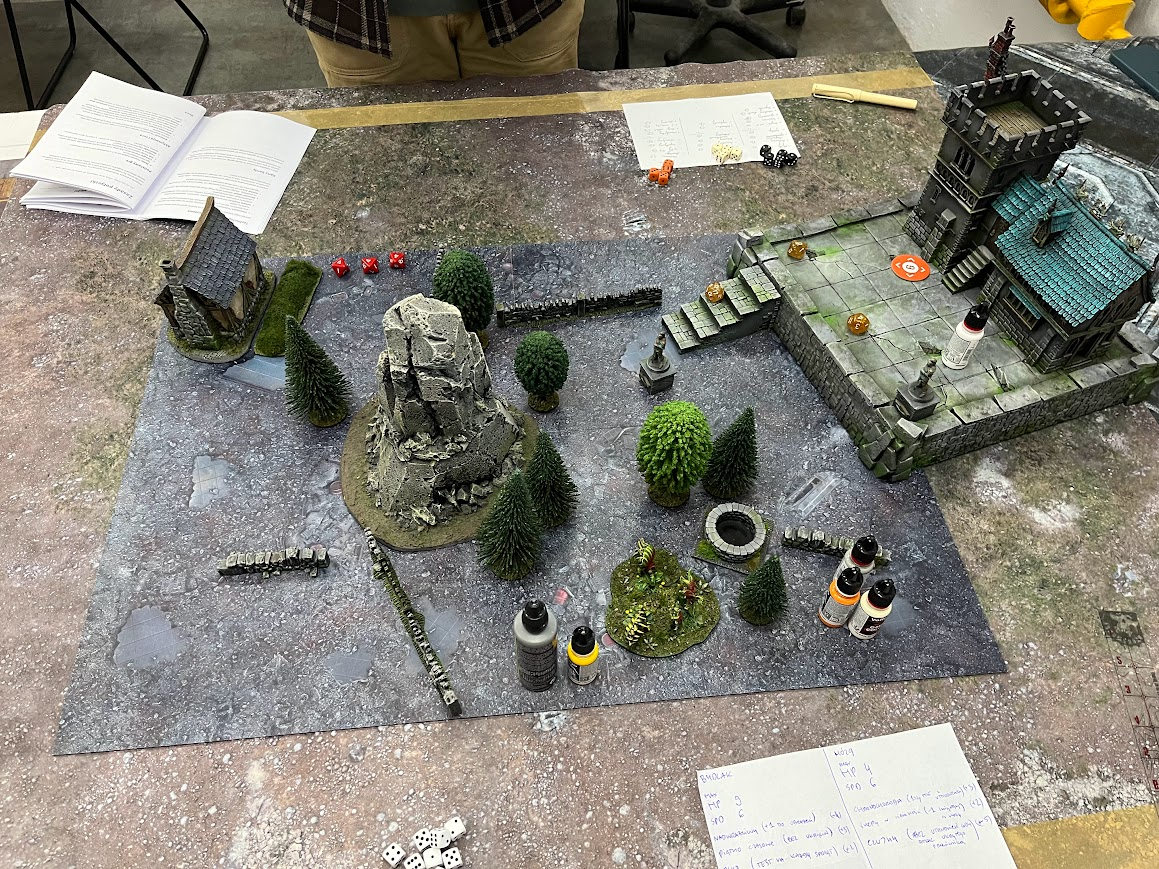
Stas’s warband started in the lower-right corner of the map as three commando layabouts: one overweight, one scrawny, and one anemic. Michał’s team deployed nearby, squeezed between a wall and a bush, consisting of a giant idiot and a commando-spy.
The enemy side was easy to read:
- red dice = the Aesthetics agents,
- gold dice = Academy guards,
- white bottle = Plato.
That is an elite visual language right there.
The game itself
For a first outing, the whole thing went really smoothly. The scenario took us about 1 hour and 10 minutes, which feels like a very good sign for a fresh system.
There was enough chaos to make it memorable, but not so much that the game collapsed under its own weirdness. We had movement, pressure from multiple sides, a clear objective, and just enough absurd narrative energy to keep us laughing.
At some point things got rough for Stas’s crew — based on the photos, one of them was probably taken after two-thirds of his band had already died. So this was not exactly a clean walk through the Academy gardens.
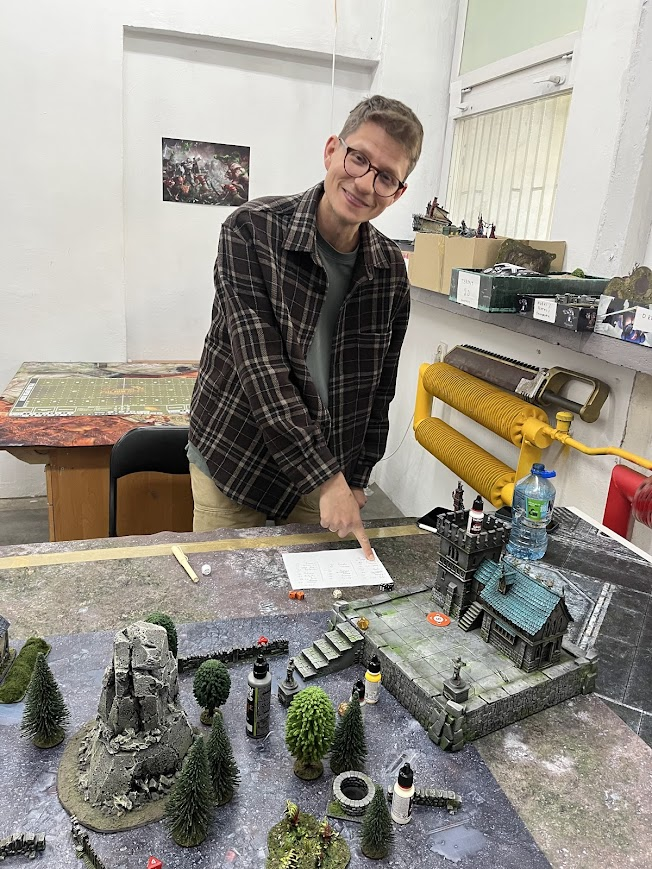
But despite casualties and general confusion, we got the job done.
Plato got the note
In the end, Plato received the message and we won.
Which means that history was successfully corrected with the help of paint pots, dice, and a level of operational professionalism that we choose not to examine too closely.
First impressions of the system
Our immediate takeaway was simple: this was fun.
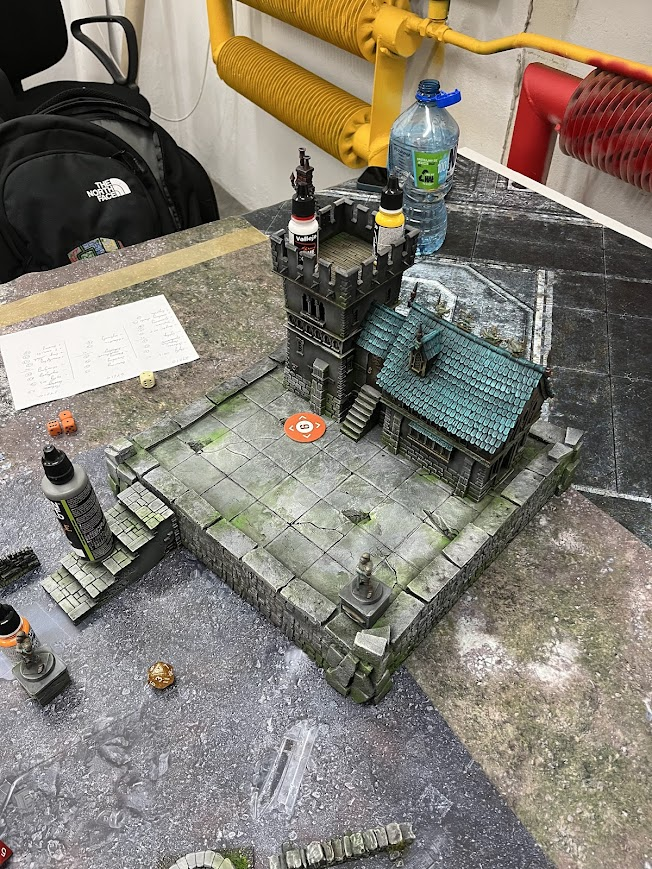
Not “fun for a prototype,” not “fun if you squint,” but actually fun. The scenario gave us a clear structure, the table state was readable even with fully improvised components, and the whole thing moved at a good pace.
That’s probably the best result we could have hoped for from a first proper test.
After the game we immediately drifted into design talk, including the equally important question of what to actually call the system. For now, there was a codename, and thankfully everyone agreed it probably needs to change.
Why we’re writing about this here
This wasn’t a Warhammer battle report in the strict sense. But it absolutely came from the same hobby brain-space: toy soldiers, scenario design, cinematic nonsense, and the joy of making a game work with whatever we had on hand.
And honestly, using paint bottles as operatives feels very on-brand for a friends’ hobby blog.
We’ll definitely be curious to see where this little system goes next — especially if future missions maintain this level of historical irresponsibility.
If the next test game is anywhere near as good, we may have to report back.
Scenario highlights
- First test game of our homemade skirmish system
- AI-generated mission set in ancient Greece
- Play time: about 1h 10m
- Components used: Vallejo paints and dice instead of minis and terrain
- Result: mission success, Plato got the note