Starting a Warhammer Paint Set Without Spending a Spearhead
We recently had one of those extremely relatable hobby conversations: we just need a few paints, and five minutes later the basket somehow costs as much as a Spearhead box. Classic.
This time the topic was a first bigger paint order: glue, basing supplies, metallics, washes, and the eternal question of whether to go for regular acrylic paints or speedpaints/contrasts. Since this comes up all the time for people starting out, we figured it was worth turning that chat into a proper post.
The first big tip: don’t buy everything at once
The biggest trap at the beginning is assuming we need a full range of Base, Layer, Shade, technicals, metallics, and ten “maybe useful” colors just in case.
You can do that, of course. But if we’re only starting, it usually makes more sense to keep the first order focused and practical.
In our chat, the key advice was simple:
- skip building a huge classic acrylic collection at the start,
- go for a speedpaint/contrast-style workflow instead,
- add just two drybrush colors,
- grab a couple of washes,
- and only a few metallics.
That gets us painting much faster, with less decision paralysis and usually for noticeably less money.
Basing glue vs model glue
There was also a very fair beginner question: is basing glue different from model glue?
The confusion came from glue for putting texture materials on the base versus glue for attaching a miniature to the base or assembling the model itself.
So yes: when someone says basing glue, they usually mean glue for sand, tufts, stones, and other scenic bits on the base — not necessarily the same thing we use for plastic joins.
In this conversation, the product mentioned was Army Painter Battlefield Basing Glue.
If you’re starting, speedpaints make life easier
The strongest recommendation in the chat was to go for one of these paint families:
- Citadel Contrast
- Vallejo Xpress Color
- Army Painter Speedpaint 2.0
The reasoning was very straightforward: if we start with regular acrylics only, getting good results takes more layering work and more practice. That’s great later, but for a first army or first batch of models, it can make the whole process harder than it needs to be.
Meanwhile, contrast/speedpaint-style paints let us get to “looks good on the table” much faster.
The easy recipe: dark primer, drybrush, then contrast
This was probably the most useful practical tip from the whole exchange.
If we’re priming dark, the suggested workflow was:
- Dark primer
- Drybrush with grey
- Drybrush with white
- Apply contrast/speedpaints
And if we’re really just starting, we can simplify it even more:
- Dark primer
- Drybrush with white only
- Apply contrast/speedpaints
That answers the question of whether the paints will work over a dark primer: yes, if we first bring the model back up with drybrushing.
For that step, the specific recommendations were:
- Vallejo Neutral Gray
- Vallejo Off-White or Vallejo Death White
The idea is simple: the drybrush creates the light values for the contrast paint to work over. It’s a beginner-friendly shortcut that gives a lot of visual payoff very quickly.
A practical starter paint list
Based on the conversation, this was the suggested set of colors:
- Baal Red
- Flesh Tearers Red
- Black Legion
- Cygor Brown
- Darkoath Flesh
- Skeleton Horde
- Dark Angels Green
- Terradon Turquoise
- Frostheart
- Agrax Earthshade
- Berserker Bloodshade
- Nuln Oil
Plus:
- a few metallics
- the two drybrush paints mentioned above
Out of that whole list, one paint got a special shoutout: Skeleton Horde. According to our notes, that was the “most important” one, especially because it’s great for bones and skulls.
Also mentioned: Berserker Bloodshade looked especially good for enriching red armor elements and skin in at least one painting reference that inspired the shopping list.
You don’t have to buy Citadel for every color
Another very useful point: even if the reference recipe uses Citadel names, we don’t have to buy the exact Citadel pot every time.
In the chat, we talked about looking for equivalents in:
- Vallejo Xpress Color
- Army Painter ranges
The big draw here is price. One of the examples mentioned was that Citadel Contrast is noticeably more expensive per pot than Vallejo Xpress, while Xpress paints can do a very similar job.
A handy tool mentioned in the discussion was ArmyCrafter, especially the “Similar speed paints” section when comparing colors:
https://armycrafter.com/paints/citadel/contrast/baal-red
That said, there was also an important caveat: paint matching online is helpful, but it’s often easiest to judge equivalents in person, because screens and product photos can be misleading.
What about metallics?
The conclusion here was refreshingly sensible: don’t overcomplicate metallics at the start.
There are fancy metallic options out there, including more unusual products like metallic contrast-style paints, but for a beginner they’re absolutely not required.
The advice from our chat was basically:
- regular metallics are enough,
- any decent metallics will do,
- and they’re especially useful for drybrushing or picking out details.
To help metallics along, Nuln Oil was specifically recommended.
And yes, one very shiny and rather expensive metallic set did appear in the discussion:
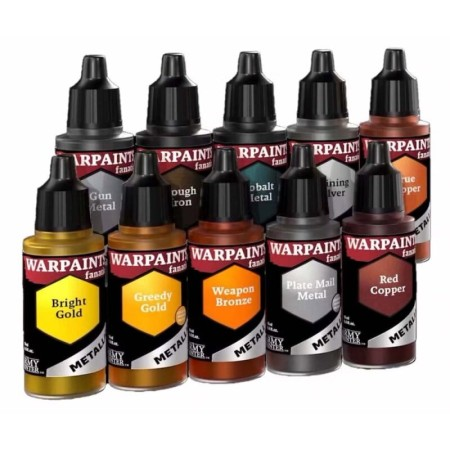
Looks cool? Absolutely. Necessary for a first order? Definitely not.
Our takeaway
If we had to boil the whole conversation down into one starter recommendation, it would be this:
Don’t try to build the perfect paint collection on day one. Build the smallest collection that gets miniatures painted.
A dark primer, two drybrush colors, a handful of contrast/speedpaint colors, a wash or two, and a couple of metallics will get us surprisingly far.
And maybe most importantly: trimming the basket a bit means we still have money left for actual miniatures.
Which, let’s be honest, is usually the real objective.