Basing experiments: too much glue, rim colour debates, and cheaper texture paste alternatives
Basing experiments: too much glue, rim colour debates, and cheaper texture paste alternatives
Sometimes the most useful hobby progress starts with a very simple thought: “I may have used way too much glue, but at least nothing is falling off.” And honestly, we respect that kind of practical energy.
This time the discussion was all about bases — texture, stones, drying time, drybrush tests, and of course the eternal question: what colour should the rim be?
When the base looks like a solid lump… but works
end3r started by testing a base texture approach with dissolved glue and terrain material. The first impression was not exactly elegant:
it’s drying for now, it just looks like a compact mass
But the important part was that nothing was coming loose, and the colour stayed the way it was supposed to. Which, for an early basing test, is already a pretty good sign.
There was also a plan to go back and fix some of the earlier bases that had been experimented on by adding a second layer of small stones. That feels very relatable — one base is a test, then suddenly the whole batch becomes a lab.
The best next step: compare, don’t guess
What we really liked here was the plan for the next day. Instead of committing blindly, end3r wanted to test three versions side by side:
- one with a drybrush,
- one with brushwork plus Nuln Oil,
- and one left untouched as a reference.
That is such a good hobby habit.
When we’re working on bases, it’s very easy to convince ourselves that something will probably look better after the next step. But putting three actual versions next to each other saves time, materials, and disappointment. A tiny controlled test on a few bases tells us much more than theory ever will.
If we had to pull one hobby tip out of this whole conversation, it would be this:
Always keep one test base as a reference.
It’s boring right up until the moment it saves you from repainting ten more.
Rim colour: black, army-specific, or matched to the base?
Then we got to one of those hobby topics that always sparks opinions: base rims.
end3r found what felt like the perfect Citadel colour for the side of the base: Steel Legion Drab. And honestly, it makes a lot of sense for a dusty, earthy scheme.
wilini took the opposite route:
I do mine black so it doesn’t stand out
Also valid. Clean black rims are classic for a reason — they frame the miniature and keep attention on the model itself.
Then michalbe added a third approach:
every army gets a different rim colour
Which is also fun, and actually pretty practical if you like visual identity across collections.
So if you’re wondering what the correct rim colour is, the answer is of course the least satisfying one: there isn’t one. But there are a few solid approaches:
- Black if you want a neutral, unobtrusive finish
- Earth tones like Steel Legion Drab if you want the rim to blend naturally with the base
- Army-specific colours if you want each force to have its own character
For this particular look, Steel Legion Drab seems to fit really well.
A useful visual reference
end3r shared an example of Salamanders with rims painted in Steel Legion Drab, and it really helps show the effect in practice.
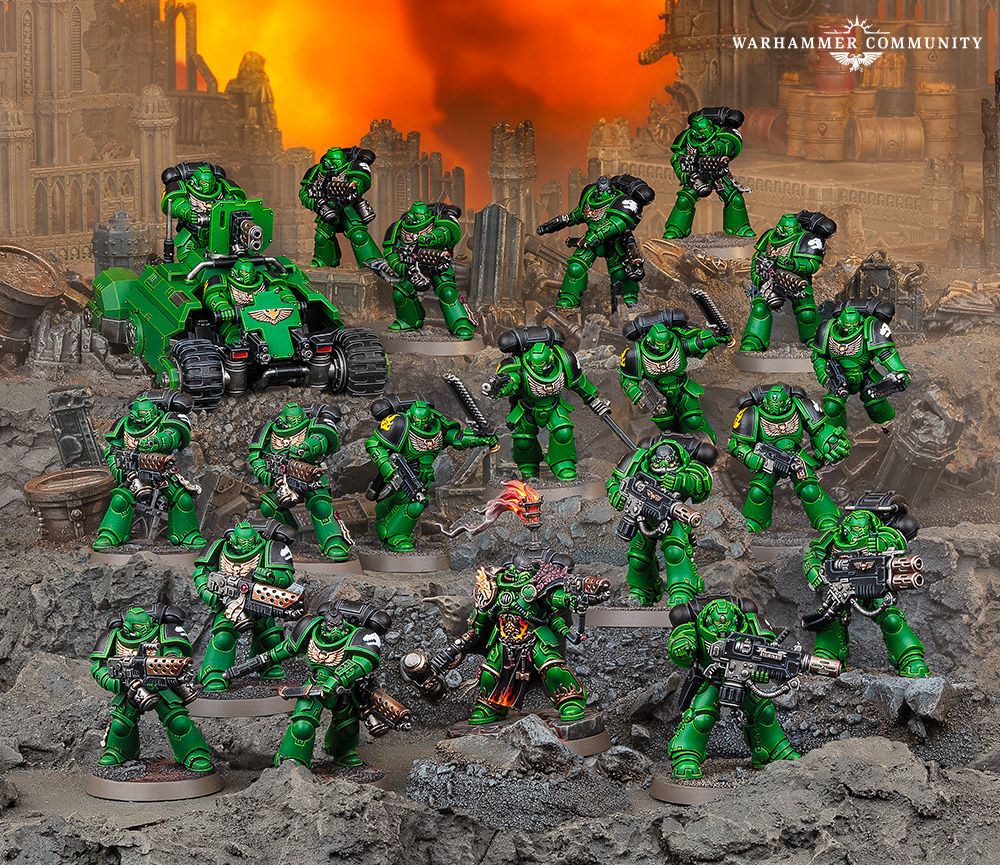
It’s a small detail, but it ties the whole base together nicely without going full black-frame mode.
Astrogranite vs Vallejo texture paste
The basing plan also included using Astrogranite for the texture, which is a very familiar starting point for a lot of Warhammer hobbyists.
But then michalbe dropped a very practical recommendation: take a look at Vallejo texture pastes instead.
The reason was simple and convincing:
- Citadel Texture: around 22 ml for 25 PLN
- Vallejo texture paste: around 200 ml for 50 PLN
That kind of price comparison gets our attention immediately.
If you’re doing only a handful of character bases, Citadel texture paints are convenient and easy to grab. But if you’re planning a full army, scenery, or just lots of experimentation, larger tubs of texture paste can be much better value.
And that’s probably the biggest practical takeaway from this part of the chat: sometimes the best hobby upgrade isn’t a new technique, but simply discovering that there’s a cheaper material that does the same job.
Our takeaway
This was one of those very normal, very useful hobby conversations that probably sounds small from the outside, but contains a lot of real process:
- apply texture
- wait for it to dry
- accept that it may look ugly before it looks good
- test multiple finishing methods
- compare rim colours
- and look for cheaper materials before committing to a whole army’s worth of basing
We like these moments because this is what hobby progress usually looks like in real life — not dramatic reveals, just small improvements, good ideas, and someone in the chat saying “hey, there’s a cheaper option for that.”
If end3r’s tests work out, we’re expecting some nicely dusty bases with a solid Steel Legion Drab rim and hopefully a method that can be repeated across the whole force without pain.
And yes, we’re also curious which version wins:
- drybrush,
- brush + Nuln,
- or the untouched control.
Sometimes the base is just the base. And sometimes it becomes the whole evening’s hobby philosophy.