Chaos Dwarfs vs Orcs & Goblins: the best Old World scrap we’ve played so far
We’ve been deep in Warhammer: The Old World prep lately, because Michał is getting ready for a tournament with 50 players — which is honestly a fantastic number and exactly the kind of event that promises tables, noise, and photos you can practically smell.
Before the event, we squeezed in another practice game: Chaos Dwarfs vs Orcs & Goblins, at 1250 points, and even though we didn’t finish the battle, we both came away with the same feeling:
this was probably the best Warhammer game we’ve played so far.
And that’s saying something.
The list: Hero Hammer with a locomotive
The starting point for the whole game was Michał’s Chaos Dwarf list, which very quickly got described in the chat as heading toward Hero Hammer. Fair enough — when you put two big mounts and an Iron Daemon into 1250 points, subtlety is no longer really the plan.
Here’s the list as it stood before the game:
- Infernal Castellan on Bale Taurus
- Daemonsmith Sorcerer on Lammasu
- Hobgoblin Khan on foot
- 24 Hobgoblin Cutthroats
- 12 Infernal Ironsworn
- Iron Daemon
We also had the usual pre-game list tinkering: whether the Hobgoblins really needed a champion, whether those points should become a pistol somewhere else, and whether taking Hobgoblins at all made sense at this level. Michał even got the classic forum advice that at 1250 points he should apparently ignore objectives, table the opponent immediately, and wrap the whole thing up in two and a half hours.
We are happy to report that our approach remained much more in line with our values: overthink the list, deploy slowly, talk for ages, then discover rules edge cases afterwards.
What actually happened on the table
This one had a bit of everything.
The biggest early swing came when the Orc Warboss on Wyvern absolutely went off and killed the Castellan on Bale Taurus. That was a huge pickup — not just a big monster, but also the general. In points terms alone, it was painful.
But the Chaos Dwarfs hit back immediately in the most Chaos Dwarf way possible: with a flying sorcerer monster breathing fire into tightly packed greenskins.
The Daemonsmith Sorcerer on Lammasu got revenge by blasting first the boar unit, then the Black Orcs, taking out well over a quarter of each unit with frightening ease. If the Bale Taurus death was the dramatic headline, the Lammasu was the steady reminder that this list still had plenty of teeth.
Meanwhile, the fanatics did what fanatics do: they caused chaos for everyone involved. They thinned out the Ironsworn, and in one final ridiculous spin, one of them also passed through the Black Orcs and killed five of them. We never got the big Black Orcs vs Ironsworn clash we were building toward — partly because time ran out, and partly because fanatics are apparently committed to disrupting all narrative structure.
The Night Goblin boss on squig, who was also the battle standard bearer, charged the flank of the Ironsworn and… died. Which was both unfortunate and, in a very Old World way, kind of perfect.
On the lighter cavalry side of things, the wolf riders had a short but memorable career, because the Iron Daemon ran them over in spectacular fashion. As Stas put it, they basically splashed under its wheels.
And yes, the Iron Daemon felt terrifying. Between Impact Hits, stomps, and its sheer statline, it absolutely looked like it could earn its points back — and in this game, it pretty much did.
At the same time, it wasn’t all smooth for the Chaos Dwarfs either:
- the boars tore through half the Hobgoblins,
- not a single Fireball went in all game,
- and at one point the Chaos Dwarf locomotive basically got lost in the field.
That combination is a big part of why the game felt so good. There were big plays, dumb moments, scary units, failed spells, and enough swings in momentum that neither side felt like it was just going through the motions.
The screenshot that launched a post-game rules spiral
After the game, we did what every healthy Warhammer group does: instead of moving on with our lives, we started digging through the rules to check what we’d missed.
One of the first follow-ups was a screenshot about a key interaction from the game — very much in the category of “well, maybe that charge wasn’t such a great idea after all.”
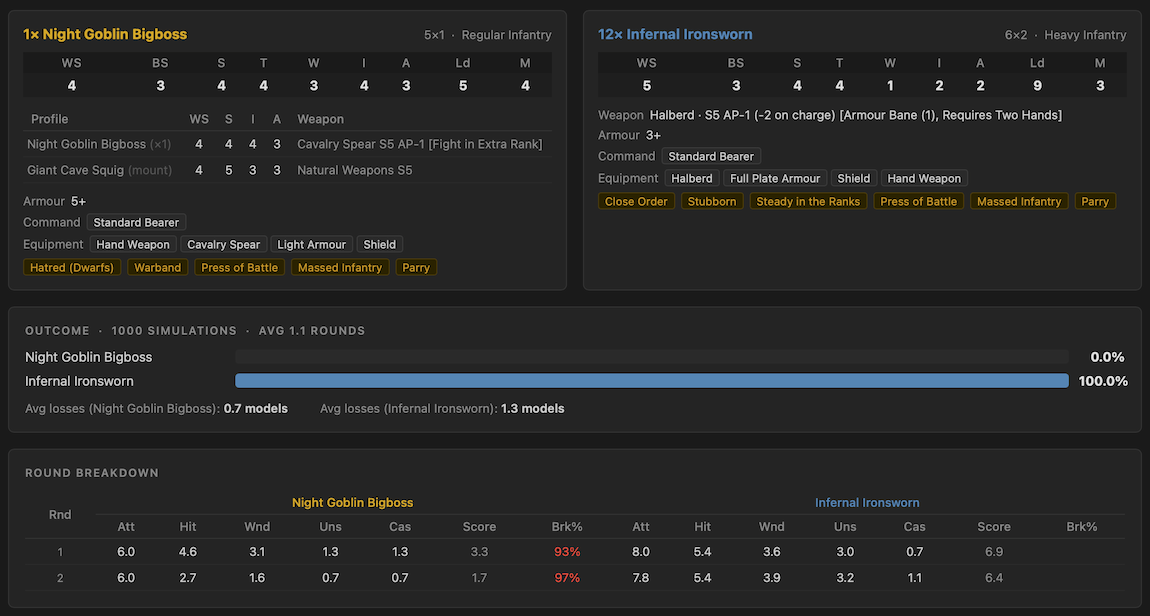
From there, the conversation escalated into a full-on Old World legal seminar.
Stomps, monsters, large targets and other friendly complications
At one point during the game we were trying to remember exactly how stomp attacks interact with bigger targets. Afterwards we checked the relevant rules and confirmed that we had remembered it only partly correctly: the distinction was about monsters, not simply all large targets, and there were also nuances around AP -2 for behemoths, rather than for all stomp attacks in general.
Because this came up repeatedly, here is the relevant rules screenshot we kept staring at:
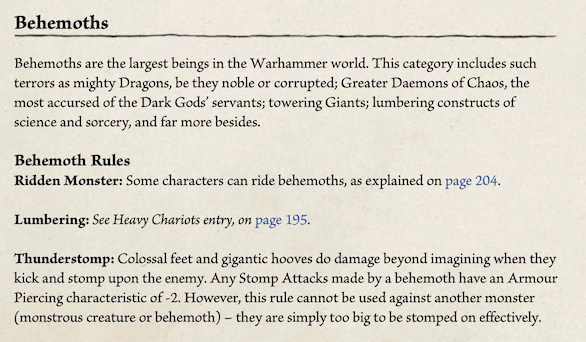
And yes — the same screenshot got posted several times in chat, which feels spiritually accurate for rules discussions in this game.
The Wyvern armour save question
Then we went further down the rabbit hole.
There was a moment of dawning horror when Stas found a rule suggesting the Wyvern should not actually have been as durable as we had played it. Not a game-breaking difference, but definitely enough to matter.
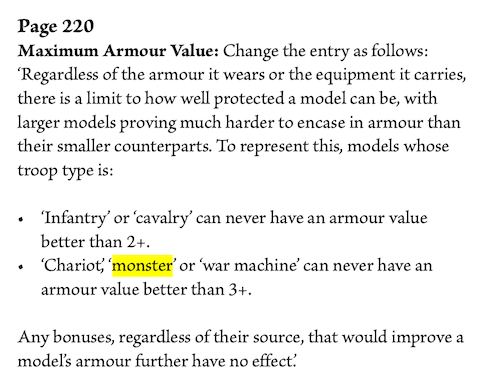
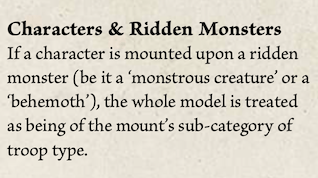
But naturally, one answer only produced another question. Shortly afterwards, another rule excerpt appeared that seemed to suggest the character can use either the mount’s or the rider’s armour value, whichever is better.
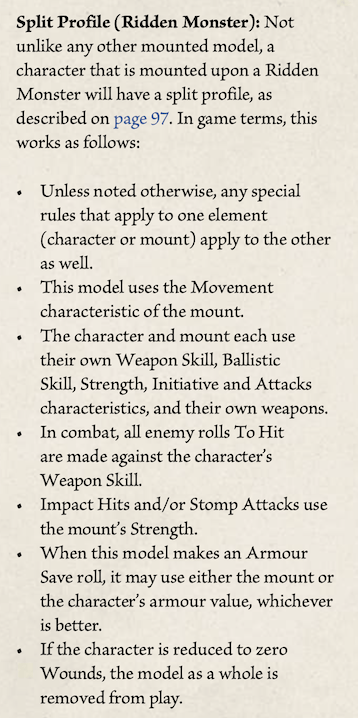
So did the 3+ cap apply only to the monster, while the rider could still benefit from a better value? Maybe. Probably. Unless another paragraph somewhere says otherwise in a footnote written during a lunar eclipse.
This is exactly the kind of thing that makes Old World both charming and mildly maddening.
What happens when the mount dies?
That discussion naturally led to another classic question: if the mount dies, does the rider continue on foot?
We checked that too, and in this case the answer was basically no, usually both are removed, because the mount does not have its own separate Wounds profile in the way you might hope.
The Iron Daemon pursuit problem
One of the most interesting post-game discoveries was about the Iron Daemon smashing the wolf riders.
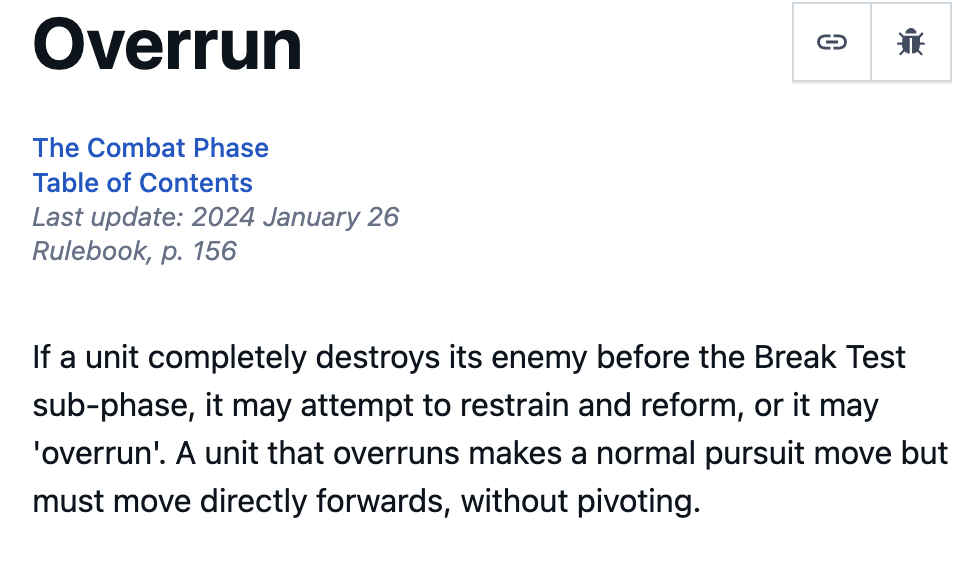
At the table, that already felt brutal. Afterwards, Michał noticed that after destroying them, the Iron Daemon should have had to pursue, which means it likely would have gone straight into the boars.
That is a genuinely important tactical detail, because it changes how screening works against that kind of threat.
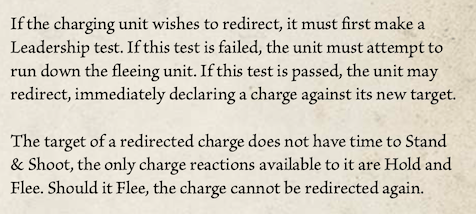
That then opened up the next question: if the Iron Daemon pursues into a fresh enemy, can the boars counter charge?
We went back to the rules again:
And then, because no rules discussion is complete without one more layer of interpretation, we also ended up staring at the wording conflict between the core restriction and the special rule permission.
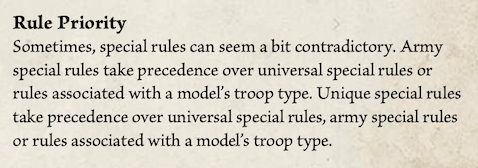
The conclusion, at least for that specific situation, was that Counter Charge did not apply, because it wasn’t happening in the front arc and it was pursuit into a fresh enemy, not a normal charge declaration.
Which is a very Old World sentence if there ever was one.
Also: musicians helping with rally is easy to forget
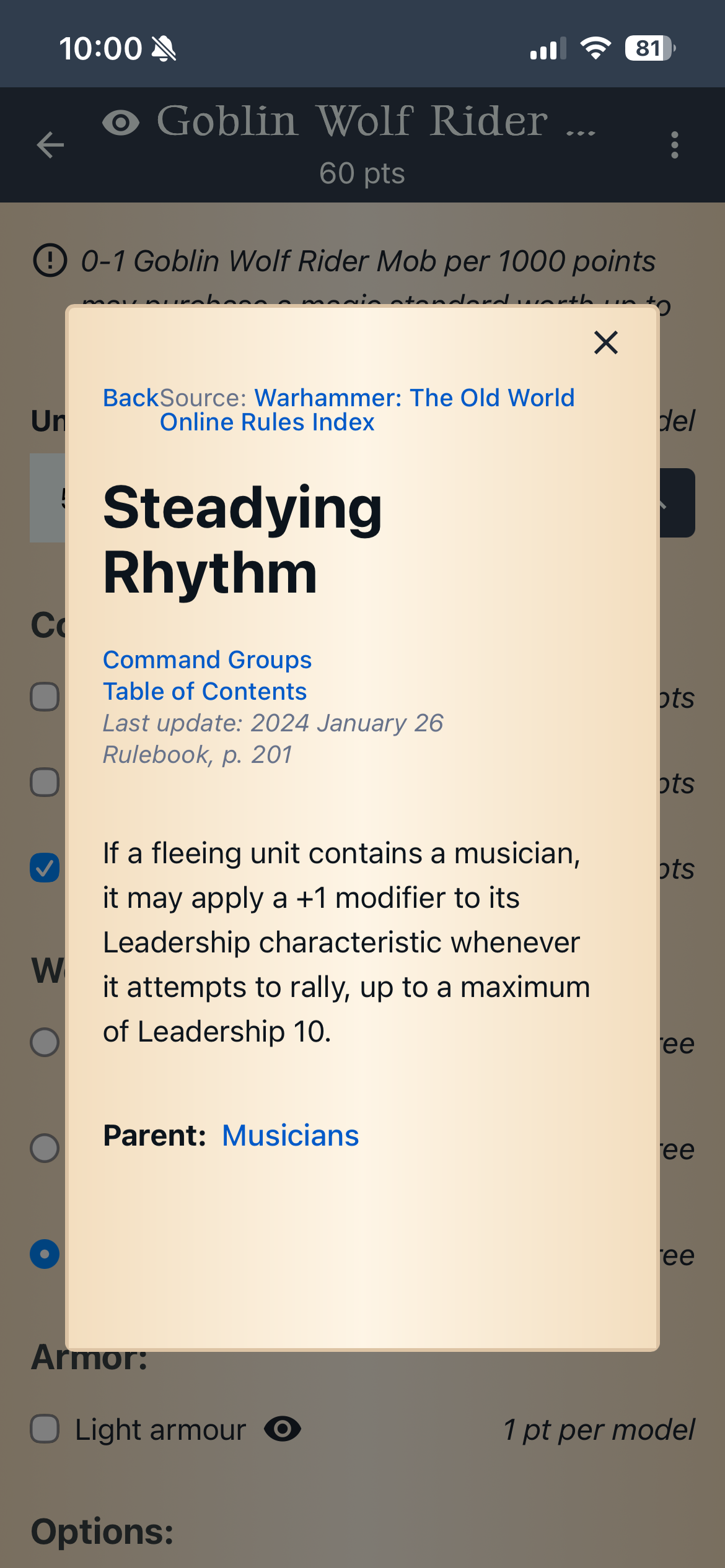
Another tiny but useful rules reminder from the same post-game debrief: yes, in The Old World, a musician helps with rallying.
That might be obvious to some people, but these are exactly the little things that slip out of your head in a game full of charts, exceptions, and unit-specific interactions.
Why this game was so much fun
What we liked most here wasn’t just that cool things happened — although they absolutely did.
It was that the game had the full package:
- a dramatic monster-on-monster kill,
- a revenge run by the Lammasu,
- fanatics doing collateral damage to friend and foe alike,
- an Iron Daemon behaving like a runaway industrial accident,
- enough mistakes and forgotten rules to fuel a long after-action discussion,
- and that very specific Old World feeling that every turn contains at least one sentence you’ve never said before in your life.
We didn’t even finish the game, which honestly is also part of the charm. The first couple of hours disappeared into deployment, talking, checking profiles, joking around, and trying to build a mental model for all the combat tables. That’s just how our games often go.
And yet somehow, instead of being frustrating, it made the whole thing better. We both came away excited, already thinking about rematches, list tweaks, and what to remember next time.
For Michał, that probably means a few more practice games before the tournament.
For the rest of us, it means one more confirmation that Warhammer: The Old World is at its best when it gives us exactly this: big swings, weird edge cases, and stories we’re still talking about the next day.