Could Square Based Comp Make More Sense for Our 500-Point Old World Games?
We had one of those very classic hobby-chat moments recently: starting from a quick look at how our games actually play out, and ending up deep in a discussion about balance, metas, and whether tiny games should maybe borrow ideas from much bigger competitive formats.
This time the topic was Square Based Comp for Warhammer: The Old World — and honestly, the more we talked about it, the more interesting it sounded, even at just 500 points.
The starting point: are all 500-point armies really equal?
Michał kicked off the discussion by looking at how our fights have been going and wondering whether a straight, equal-points format is really the best way to handle small games.
His thought was simple: maybe it would make more sense if we used Square Based Comp scaling even at 500 points.
Under that idea, some factions would effectively get more room to breathe:
- Bretonnia — 550 points
- Orcs & Goblins — 550 points
- Empire of Man / Expeditionary Force — 550 points
- Skaven — 600 points
- Daemons of Chaos — 650 points
That alone is a fun thing to think about for army-building, because it changes the question from “what is the most efficient 500-point list?” to “what does this faction actually need to feel like itself on the table?”
So what is Square Based Comp, exactly?
Pegie asked the obvious and very fair question: what does that even mean?
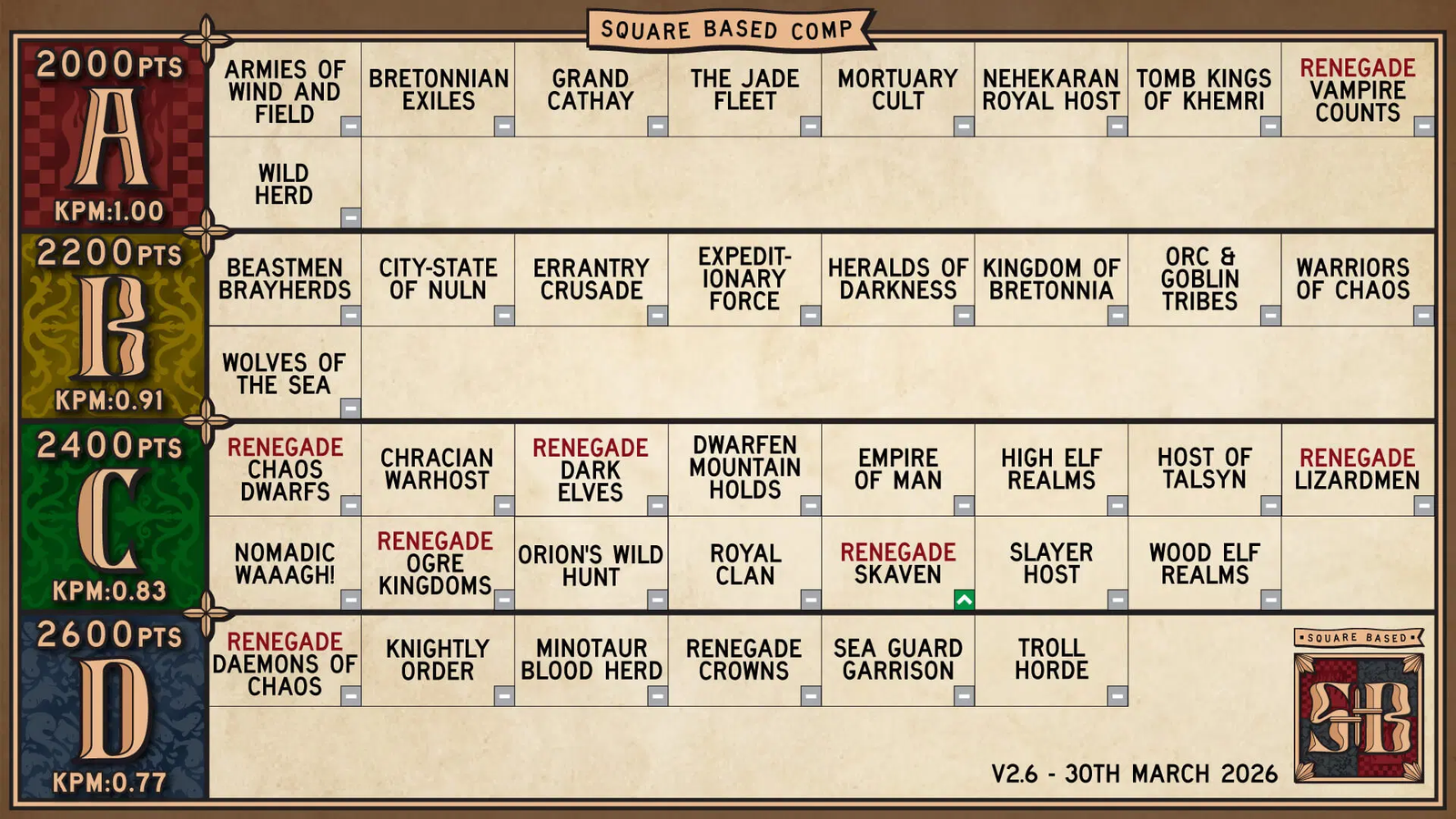
Michał explained that Square Based Comp is a set of rules used for 2000-point games, including at TSN Arena, which he described as probably the most popular place for playing The Old World in Europe, in Nottingham, England. They apparently run large tournaments there basically every weekend, and after a lot of games they came to a pretty practical conclusion:
not every 2000-point army is equally strong just because the number says 2000.
And that is honestly the whole heart of the system.
Instead of pretending every faction scales equally, they tweak the points by tier. In Michał’s summary, for a 2000-point event it looks like this:
- Tier A plays at 2000
- Tier B plays at 2200
- Tier C plays at 2400
- Tier D plays at 2600
Then, to keep scoring fair, the points you destroy are adjusted by a KPM multiplier. So if you kill 1000 points of an army that brought a bigger compensated list, you do not necessarily score the full raw amount.
His example was Daemons of Chaos: if you kill 1000 points of Daemons, you might score only 770 points for it, because they had a much larger compensated army on the table to begin with.
That part is really important. This is not just “give weaker factions free stuff.” It is trying to balance both list construction and result scoring.
Why this is interesting for small games
What we liked about this conversation is that it was not just abstract theorycrafting. It came from looking at actual games and asking whether the factions feel right at low points.
At 500 points, some armies can still do their thing pretty naturally, while others feel cramped, unfinished, or forced into awkward choices. If a faction is already struggling structurally, tiny games can amplify that even more.
Michał mentioned that the people behind the comp system have talked in their videos about how, for example, 2400 points of Skaven did not even necessarily feel excessive into something like 2000 points of Tomb Kings. That says a lot about how uneven “equal points” can be between books.
And yes, he also put it in far more direct terms: some armies just are not operating on the same level, and a flat points cap does not magically fix that.
The Daemons question
Pegie also raised a good follow-up: are Daemons of Chaos getting that kind of bonus mainly because their units are just expensive?
Michał’s answer was basically: not really.
According to him, the issue is more that the Daemons rulebook is not in a great place, and that the army is missing some things it probably needs to function properly. So the compensation is less about raw unit cost and more about the overall state of the faction.
He also noted that it will be worth revisiting this whole topic soon, because in about three weeks we should see how things change once the corrected Renegade material is out.
That is another nice reminder that these discussions are never fully static. Army-building in The Old World is tied not only to points and unit choices, but also to how healthy each book currently is.
Why we like this kind of idea
We are not saying this is automatically the perfect solution for every casual evening game. But as a thought experiment — and maybe even as a practical house rule for small formats — it is very appealing.
What we like most is that it tries to answer a real problem:
- some factions scale badly at low points,
- some books are simply stronger or weaker,
- and “same points for everyone” does not always create the fairest or most fun game.
For army-building, that is huge. It means list design stops being only about squeezing efficiency and starts being about making sure each faction gets enough space to actually play the game it was designed for.
We may test this ourselves
Right now this is still very much in the interesting idea worth exploring category for us. But it definitely feels like the kind of thing we might want to test in our own 500-point Old World games.
Because if giving a few armies an extra 50, 100, or 150 points makes the games feel closer, more interactive, and more representative of what those factions are supposed to do — then that sounds like a pretty good experiment.
And honestly, that is one of the most fun parts of the hobby anyway: not just building armies, but also figuring out how we actually want to play them.