Small Table, Big Questions: Fleeing, Returning, and Give Ground in Cinquecento
We have been talking a lot lately about compact Warhammer games, and one topic came up that felt worth writing down properly: what happens on a 30x44 table when fleeing, breaking, and returning units start interacting with the board edge in awkward ways?
This came out of our recent Cinquecento discussions. In almost every game, something similar had happened: there were definitely emotions, definitely drama, but also a growing feeling that some situations on a small table might not be entirely fair.
Stas summed it up well: we really do not want to give up playing on 30x44. It is a genuinely great format for quick games at someone’s place, easy setup, and compact armies. That part is still a huge plus for us.
At the same time, the smaller battlefield clearly makes some edge-case interactions much more common than they would be on a larger table.
The core problem
The discussion started around fleeing and what happens when a unit breaks close to the board edge. On a compact table, there is simply much less space for all those post-combat movements, retreats, and returns.
Stas threw out a couple of possible ideas:
- imagine a larger virtual table only for the purposes of flee-related movement,
- or allow units that ended up off the board after breaking to make one more rally attempt in the following turn.
Then came the immediate rules doubt: maybe that does not even count as a classic flee move, so perhaps that kind of workaround would not apply cleanly after all.
And that is really the heart of the issue. On small tables, we start looking for practical fixes very quickly, but the moment we do, we run into the question of whether we are still solving a gameplay problem or already bending the rules too far.
The table-edge headache in one image
Michał brought up the most practical version of the problem: where exactly is a unit supposed to come back if the enemy chasing it is standing just 1 inch from the edge?
That picture captures the whole thing perfectly. On a larger battlefield, this kind of situation can still happen, but on a 30x44 table it feels like it happens all the time. Distances collapse, the edge is always close, and suddenly normal movement logic starts producing very weird outcomes.
What the rules seem to say
Stas pointed out an important bit from the rules: if a unit cannot return exactly to the place where it left the battlefield, it should come back as close to that point as possible.
That is actually a very helpful anchor, because it gives us at least a rules-based way to resolve some of these situations without inventing too much.
So if the exact return position is blocked or impossible, we are not necessarily stuck. We place the unit as near as we can to that original point of exit.
And then there is Give Ground…
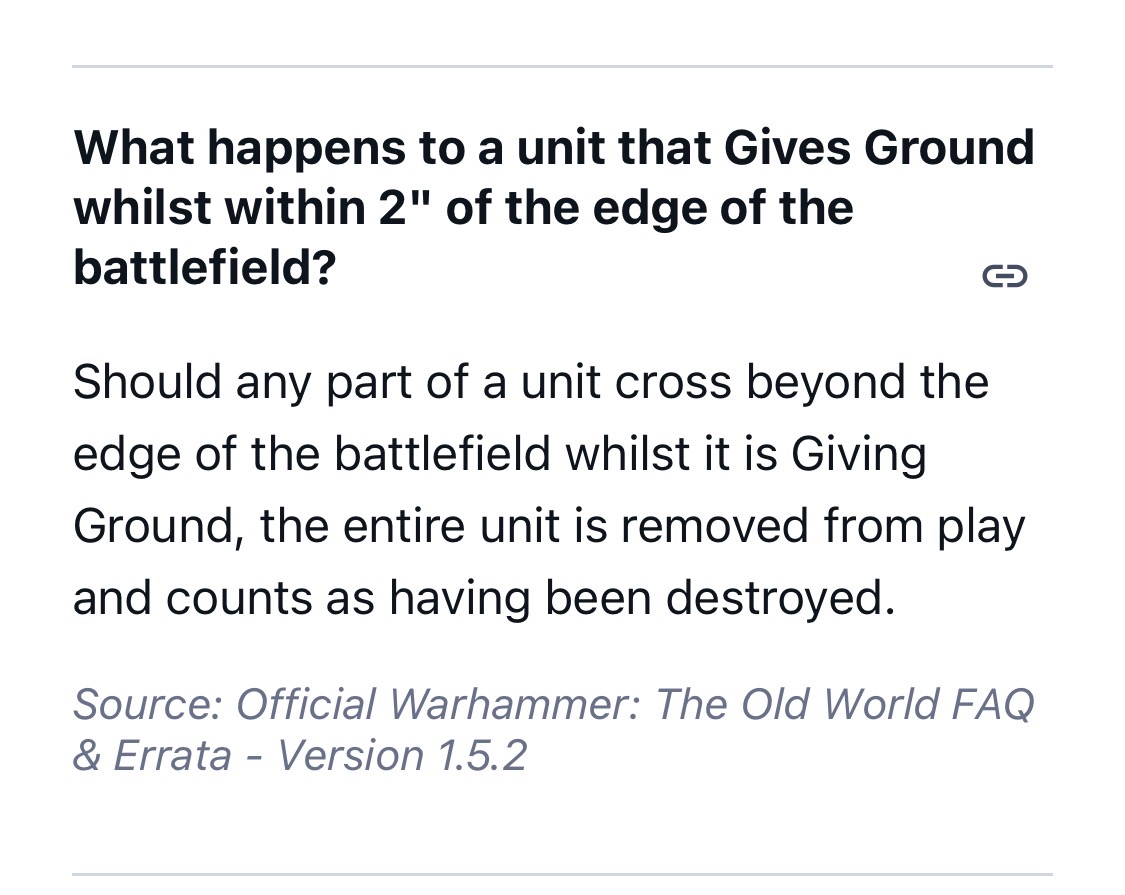
The other part of the conversation was even more brutal: Give Ground on small maps.
The reaction was basically immediate: wow. On compact boards, it can get nasty very fast.
That makes sense. Any rule that pushes units backward, repositions them, or compresses space gets amplified when there is just less room to work with. What feels like a normal result on a standard battlefield can become completely game-defining on a smaller one.
Our current takeaway
Right now, we are not presenting this as a final answer or house rule package. It is more of a hobby note from the table: if you are enjoying small-format Warhammer games, especially on 30x44, it is worth talking through these interactions with your opponent before the game starts.
For us, the most useful takeaways so far are:
- 30x44 is still great for fast and accessible games,
- fleeing/breaking interactions near the edge show up much more often on compact tables,
- the rules do seem to support returning as close as possible if the exact spot is unavailable,
- and Give Ground can become much harsher than expected on small battlefields.
So for now, we are still in the “let’s think this through” stage rather than the “we solved it” stage. But honestly, that is also part of the fun. These little format experiments always reveal where the game behaves differently, and talking that through together is half the hobby.
If we end up testing a clean house approach for compact-table flee and return situations, we will definitely write a follow-up.