Portrait, Landscape, and a Lot of Skeletons: figuring out Spearhead vs Battle
We had one of those very relatable Age of Sigmar rules-discussion moments recently: a simple question turned into a proper little expedition through warscroll layouts, Skeleton abilities, weird wording, and wildly conflicting tier-list takes.
The starting point was innocent enough: how do we actually tell what applies to full Battle and what applies to Spearhead?
At first glance, the book layout can make this feel more mysterious than it probably should. Our working shortcut quickly became:
- portrait pages = Battle
- landscape pages = Spearhead
That is, as Michał put it, roughly true.
What seems to carry over, and what does not
The first useful observation was that Spearhead strips out some of the bigger army-construction layers. No lores, no formations, no traits there. So if you’re reading the earlier faction material and wondering whether all of it applies to Spearhead too, the answer seems to be: not really.
At the same time, this is not a total reset. Unit profiles can look very similar between the two modes. When we compared examples like Skaven, Sylvaneth, and especially Skeletons, the core stats looked familiar enough that it was easy to assume everything was identical.
But of course, it isn’t that simple.
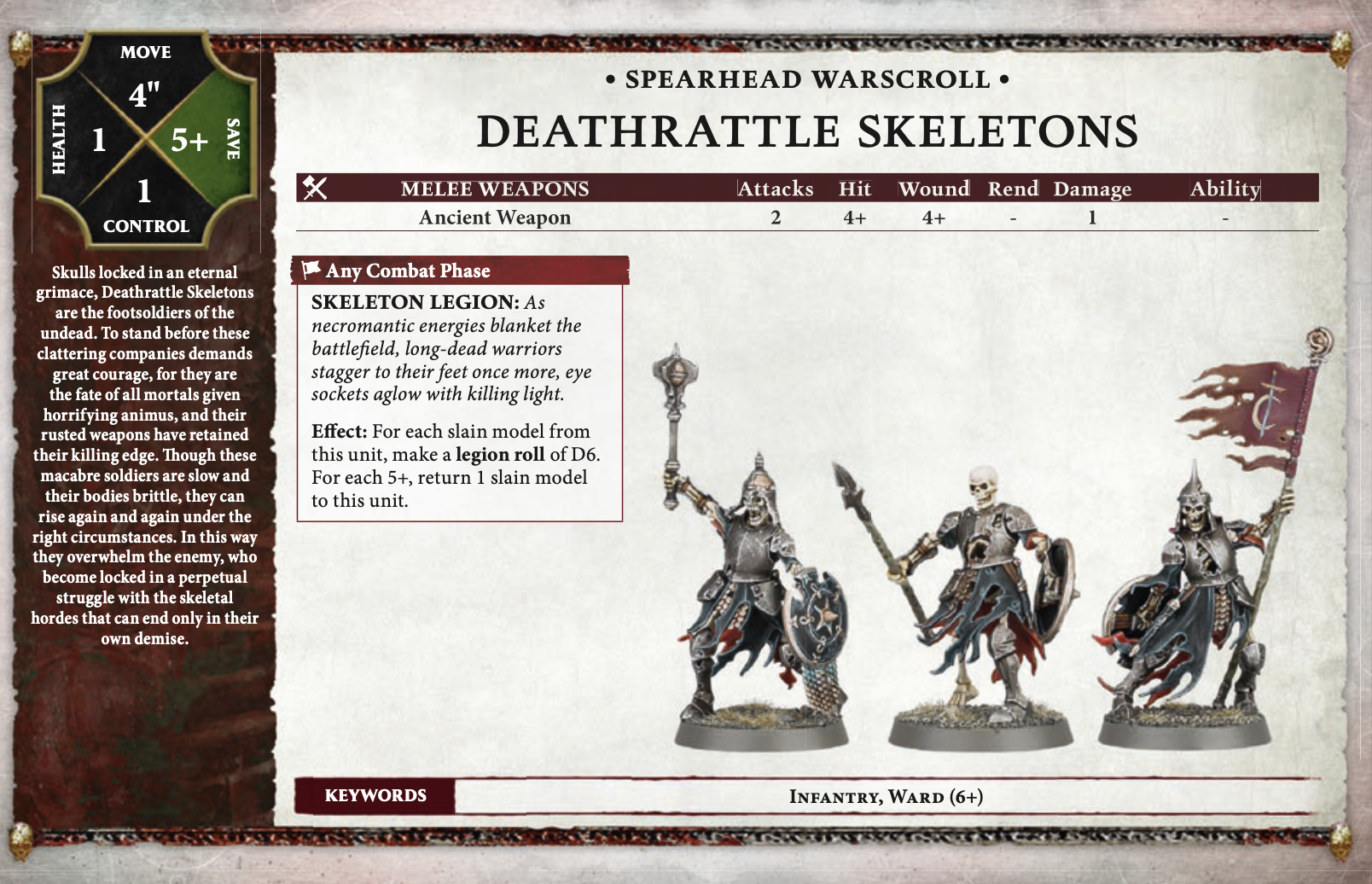
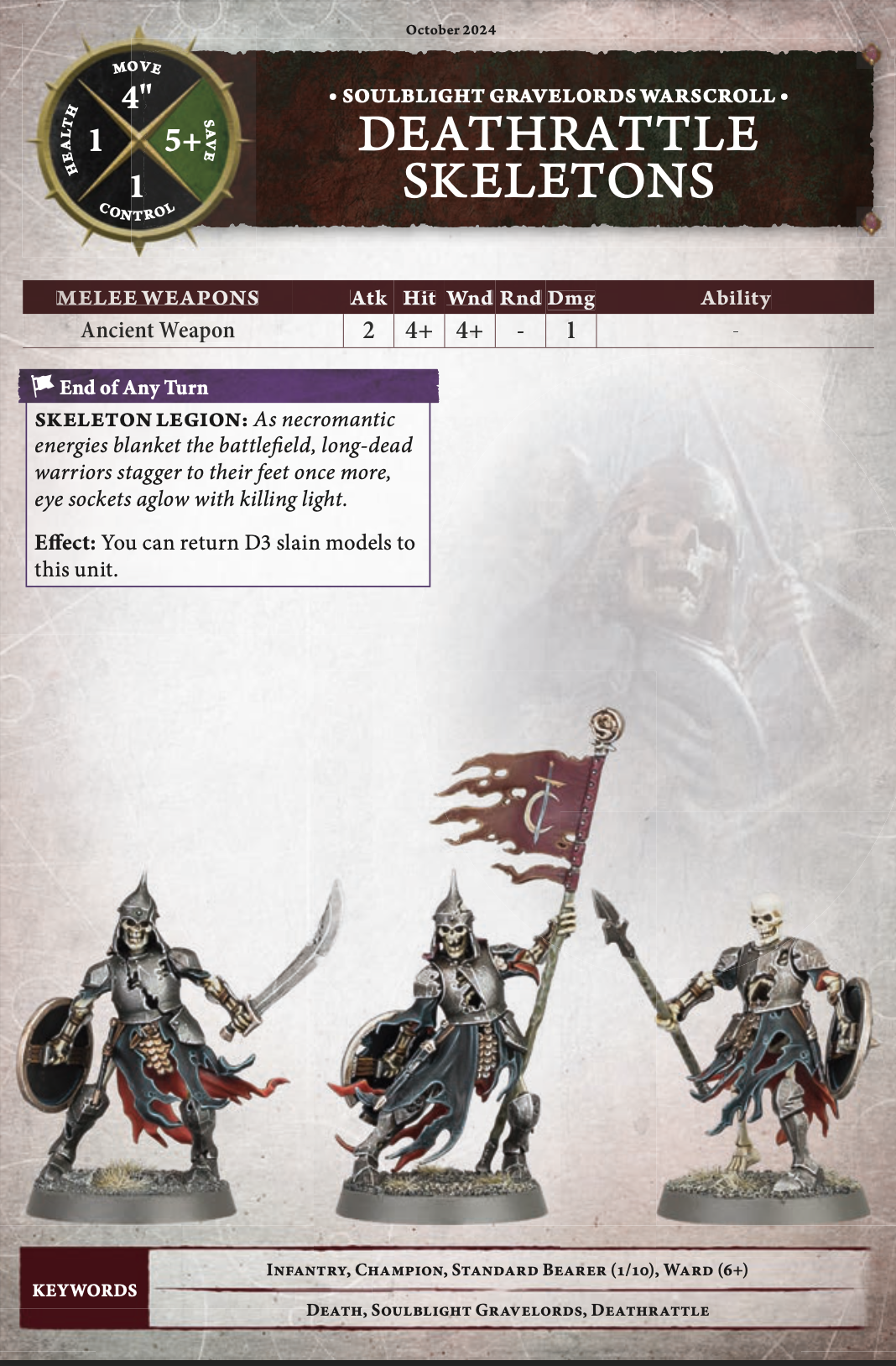
The Skeleton comparison was the point where the distinction became much clearer. The stats may line up closely, but the abilities are not always the same. In Spearhead, some of the extra bits you might expect from the Battle version simply are not there — things like special keywords or additional rules interactions can be cut down or reworked.
So the better summary is probably:
Spearhead uses familiar unit foundations, but not necessarily the same rules package.
That feels important if you’re buying a box as an entry point and trying to understand how smoothly it scales into the full game.
The “Legion Roll” detour
Then we hit one of those classic rules-reading speed bumps: what on earth is a “legion roll”?
At first it looked like some hidden core mechanic. Then it started sounding suspiciously like a faction-specific label. Eventually that turned out to be the right read: “legion roll” is basically a named roll used for internal synergy wording, not some universal game term we had all somehow missed.
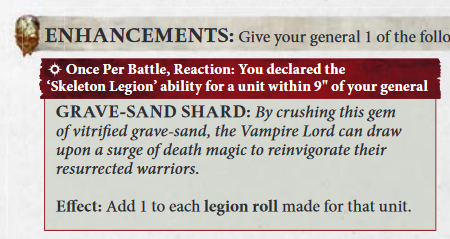
That kind of terminology is very Warhammer. Sometimes the hardest part is not the rule itself, but working out whether a phrase is:
- a core rules concept,
- a faction keyword,
- or just a cool-sounding name for a very specific interaction.
Skeletons that refuse to stay dead
Naturally, once we were staring at Skeleton rules, we immediately drifted into the more important question:
how annoying are these things actually going to be on the table?
The answer seems to be: pretty annoying, unless you delete the whole unit cleanly.
Our read was that as long as the unit is not removed entirely in a single combat phase, it has a very good chance of coming back and continuing to be a nuisance. On paper, the unit does not look terrifying — 5+ save, 1 health, 10 models — but then you add recursion and a 6+ ward, and suddenly it starts to feel like the kind of unit that exists mainly to waste your patience.
And if the whole unit does get removed, there was still another resurrection-style rule in the conversation — though importantly, not an infinite loop.
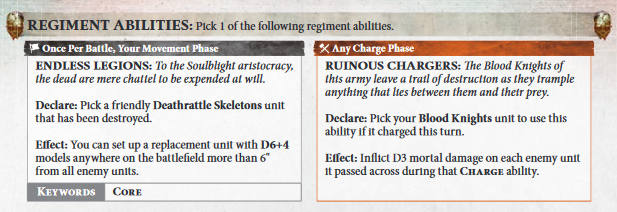
As we quickly noticed, the name sounds much more dramatic than the actual timing. It is once per battle, not some endless stream of bones crawling back onto the objective forever.
Still, the mental image was great.
The match-up we now want to see
At some point the discussion produced the most important outcome any rules chat can produce: a dumb and beautiful game idea.
Two units of Skeletons vs two units of Clanrats.
That sounds like one of those battles where nobody truly wins, but everyone regenerates just enough to keep the suffering going. Clanrats bring their own style of recursion and reinforcement tricks, while Skeletons do their best impression of a unit that was never properly destroyed in the first place.
Would it be elegant? No. Would it be cinematic? Absolutely.
Tier lists, updates, and the eternal problem of internet certainty
The second half of the conversation took a very modern turn: who is actually good in Spearhead right now?
And, as always, the answer depends entirely on which video you watched most recently.
We had one take saying Soulblight Gravelords are S-tier, overpowered, and maybe even heading for future buffs. Then another take appeared where Lumineth were apparently above S-tier. Then another source claimed the exact opposite: that Lumineth in Spearhead are miserable, maybe even the worst Spearhead force around, and that the box makes more sense as a route into full Battle than as a competitive Spearhead purchase.
That is a pretty perfect snapshot of online Warhammer discourse:
- one creator says a faction is broken,
- another says it is unplayable,
- both sound confident,
- and meanwhile one of us has already started painting and forgotten what video was even being discussed.
Honestly, that last part might be the healthiest approach.
Our takeaway
What we got out of this little discussion was less “final verdict” and more a useful hobby rule of thumb:
- Spearhead is not just mini-Battle.
- A warscroll may look familiar while still playing differently.
- Faction-specific wording can be more confusing than the actual mechanic.
- And if you’re judging armies by tier lists alone, make sure you check when the video was made and what format it is really talking about.
Also, if a unit of Skeletons looks harmless, it probably is not.
And if we ever do get that Skeletons vs Clanrats game on the table, we already know one thing: it is going to be extremely stupid in exactly the right way.