Don’t Ask ChatGPT About Skyvessels: A Small Kharadron Rules Reality Check
We love that stage of army-building where list ideas immediately turn into rules questions, weird combos, and increasingly confident interpretations that may or may not survive first contact with the actual wording. This time it was Kharadron Overlords and their skyvessels.
The whole discussion started with a very tempting idea: if a skyvessel can go in the clouds, and nothing explicitly says it can’t be in combat first… then maybe this becomes a kind of super-retreat with ridiculous range?
At first glance, it sounded spicy.
Then the actual rules reading began.
The trap: building plans on a misread rule
The initial thought was roughly this:
- use Fly High / Descend on a frigate,
- potentially take the passengers with it,
- disappear from one place,
- reappear somewhere else on the battlefield,
- and maybe use that to escape combat and redeploy aggressively.
If that worked the way we first imagined, it would be an incredible army-building tool. Not just for mobility, but for list design in general — because suddenly a skyvessel package could threaten backfield objectives, reposition key units, and potentially dodge bad engagements in a way that would massively change how we evaluate the army.
The problem is: that’s not how it works.
“In the clouds” means off the table
Michał quickly pointed out that this reads much more like the Skaven-style “in the tunnels below” mechanic:
- the unit/regiment is effectively off the map,
- this is tied to deployment,
- and it’s not a mid-combat panic button.
That was the key correction.
The decisive bit in our chat was that Flying High is used once per battle, in the deployment phase. And deployment phase is, well, deployment phase — not a thing that comes back every round.
So the whole “I’ll just leave combat and teleport away” plan collapsed immediately.
Which, honestly, is probably healthy for the game.
What the rule seems to do instead
The important wording Michał highlighted was that this applies to a regiment from which no units were deployed.
That changes everything.
So instead of:
- placing the unit normally at the start of the game,
- and then later trying to yoink it across the board,
what you actually do is:
- not deploy it onto the battlefield at all,
- keep it off-board,
- and then bring it in during a later movement phase according to the rule.
That’s a completely different use case — and a much more interesting one for army-building.
Because now we’re not talking about a combat escape trick. We’re talking about positional pressure from reserve.
Why this still looks very strong
Even after the dream of “retreat from combat with a flying boat” died, we still ended up thinking this mechanic sounds really powerful.
Why?
Because reserve deployment like this can still do a lot:
- threaten enemy backfield,
- pressure objectives in enemy territory,
- force screening,
- punish greedy deployment,
- and create a very different board state from turn one onward.
Michał’s immediate read was that this can be great for snatching an objective in enemy territory or forcing awkward responses. And that absolutely sounds like the kind of rule that changes how both players deploy.
So from an army-building perspective, this is still a big deal — just not for the reason we first thought.
The real lesson: don’t outsource rules confidence to a hallucinating machine
At some point the discussion reached its natural conclusion:
KłamczuchGPT had been cooking.
And yes, we even had a screenshot moment.
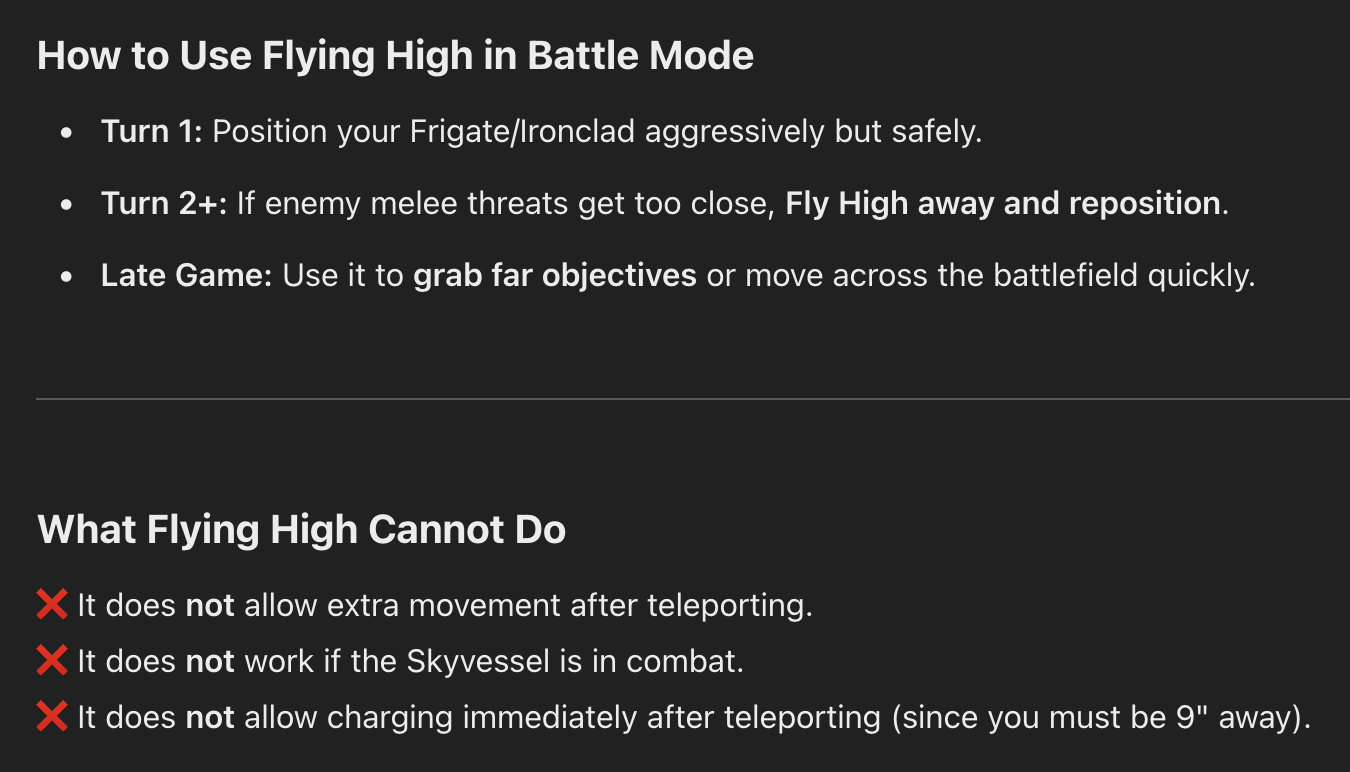
This was one of those classic hobby situations where AI gives you an answer that sounds tidy, plausible, and completely dangerous if you build your expectations around it.
We’ve all done it at this point: ask a bot because the wording is hard to find, get a confident answer, and only later discover that the confidence was doing most of the work.
So the actual takeaway here is simple:
- use tools to find sources,
- don’t use them as the source,
- and if a rule sounds absurdly good, double-check the exact wording.
In this case, Wahapedia was the practical rescue line during the chat, because it was easier to verify the wording directly there than to keep arguing with a machine improvising Age of Sigmar rules.
What we’re watching next
The conversation naturally drifted into local meta curiosity, because now we really want to see how Kharadron Overlords perform in practice — especially in league play.
There was immediate hype for an upcoming KO game, partly because one of us wants to show up and take notes like a deranged sky-dwarf ethnographer.
If the army is still undefeated in local games while its pilot is supposedly “still learning and playing slowly,” then obviously our interest level goes up.
Because that’s the fun part of army-building too: not just reading a rule in isolation, but seeing what it actually does on the table.
Final thought
So no — skyvessels do not appear to be a magical “leave combat and redeploy across the map” button.
But yes — the reserve-style deployment angle still looks strong, and probably much more strategically important than the first meme interpretation.
Sometimes army-building starts with a broken combo fantasy and ends with a more grounded, better understanding of what the army is actually trying to do.
And honestly, that’s still a win.