Trying to Understand Nagash: A Small Rules Rabbit Hole with Big Army-Building Implications
It started with a rules headache
Sometimes army-building starts with a cool idea. Sometimes it starts with us staring at a rule and asking: wait, what does this actually mean?
That was exactly the case this time, when we got stuck on Nagash and his casting rules. At first we were trying to understand how the bonus to casting keeps stacking. The wording made it sound like you keep adding +2 as long as the cast succeeds, which immediately raised the obvious question: if the bonus keeps growing, does that mean he can just keep slinging spells forever until the universe gives up?
Stas was trying to unpack the logic step by step: we add 2, that makes the next cast easier, so it succeeds more often… but then what happens when it finally fails?
And honestly, that question sent us straight into the classic Warhammer zone of:
- this seems absurd,
- but the wording kind of points there,
- and there is apparently no FAQ to save us.
The missing piece
In the middle of all that, another important rule surfaced: Nagash’s wizard level is not just about casting spells, but also about banishing manifestations. That immediately made the whole thing even more interesting, because this is not only raw magical output, but also control over stuff already on the table.
That included the kind of manifestation we already knew from Michał’s infamous bell.
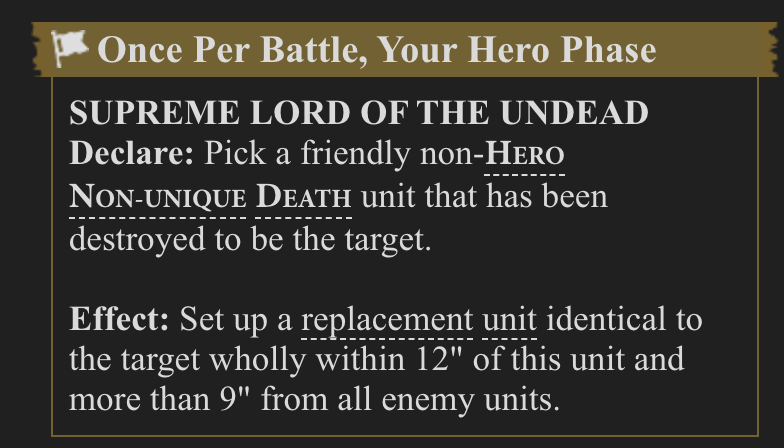
Then came the moment that really made us stop and stare at the list-building implications: you can take Nagash and Skeletons for 2000 points, and then still start thinking about adding even more bodies to the army plan. At that point the conversation stopped being only about one weird rule interaction and became a proper army-building discussion.
Because if a centerpiece model:
- dominates the magic phase,
- interacts with manifestations,
- and still leaves room for a pile of undead bodies,
then suddenly the whole list starts building itself around one giant question: how much of the army do we want to funnel into enabling Nagash?
So what actually happens on a miscast?
At one point we were wondering whether maybe the intended limiter was that he ultimately has to get a certain number of successful spells through, or whether miscasts somehow do not “spend” the budget in the way we first assumed. But the wording still felt off, and none of us were fully convinced.
Eventually Michał did the most sensible thing possible: he asked on a group.
And that gave us the answer.
Normally, if you miscast, you cannot continue casting in that same turn.
Nagash can.
That one clarification suddenly made the whole rule make sense.
It is not that he casts infinitely in some broken, literal way. It is that the usual brake on a magic phase — miscasting and being done for the turn — does not shut him down the way it shuts down other wizards. Once we understood that, the rest of the rule stopped feeling like nonsense and started feeling like exactly what Nagash is supposed to be: terrifying, excessive, and very much built to bend the normal rules of magic.
Why this matters for army-building
This was one of those moments where a rules clarification completely changes how we look at a list.
Without that clarification, Nagash reads like either:
- a rules disaster,
- a wording mistake,
- or something so extreme that it is hard to evaluate sensibly.
With the clarification, he becomes much easier to place in army-building terms. He is still absurdly powerful, of course — because he is Nagash — but now the important question is not “is this infinite?” but rather:
- how reliably can he keep a magic phase going,
- how much value does he generate from repeated casts,
- how much utility do we get from banishing manifestations,
- and what is the minimum support package we want around him?
That is where the Skeleton wall starts becoming really attractive. If such a huge chunk of your list is invested in one magical monster of a model, then cheap bodies to hold space, screen, and score start making a lot of sense.
So yes, this started as a confused rules chat. But it ended as a very real army-building thought experiment: how lean can a Nagash list be, and how much board control can we still squeeze out of the rest of the points?
Our favorite kind of hobby discussion
We love this kind of conversation because it sits right on the border between rules reading, theorycrafting, and list-building nonsense. One minute we are trying to parse a sentence, the next minute we are imagining Nagash marching onto the table with a carpet of Skeletons and bullying the entire magic phase.
In the end, the key takeaway was simple: the rule looked wild because Nagash is, in fact, wild — but there is structure behind it.
And as soon as we understood that miscasts normally stop casting for the turn, while Nagash gets to keep going, suddenly a lot of things clicked into place.
Which, naturally, only made us want to build even dumber lists around him.