Excess Damage in Age of Sigmar: one of those rules that can flip a whole game
Excess Damage in Age of Sigmar: one of those rules that can flip a whole game
Sometimes the best hobby tips come from total rules confusion.
We recently had one of those classic group moments: someone says “wait, does this really work like that?”, someone else compares it to another system, half the chat starts mentally rewriting previous games, and a few minutes later it turns out the answer is… not what some of us expected.
This time the topic was damage allocation in Age of Sigmar, especially the question of whether excess damage is wasted.
Where the confusion started
At first, we were thinking about the familiar situation from other systems:
- one attack deals a lot of damage,
- the defending model has only 1 Wound,
- so maybe the extra damage disappears.
That line of thinking makes sense if you’re coming from Warhammer 40k, where a single attack with high Damage generally doesn’t spill over to kill multiple 1-Wound models, while mortal wounds are handled differently.
So naturally, for a moment, it felt like AoS might work the same way.
The important clarification
Then Michał checked with the league group and came back with the key point: in Age of Sigmar, there is no general rule saying excess damage from an attack is wasted in the way some of us first assumed.
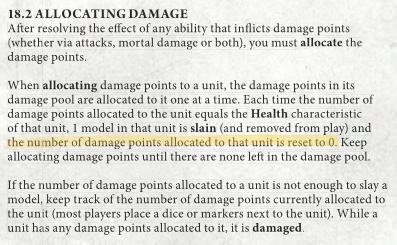
The crucial distinction is in how the rules talk about allocating damage to a unit and then resetting the damage allocated to a slain model — not clearing some imaginary global “damage pool” every time a model dies.
That sounds dry, but in practice it matters a lot.
The example that made it click
The explanation that finally made it land for us was this:
Let’s say a unit has models with 2 Wounds each, and the unit suffers 5 damage.
What happens?
- Allocate 1 damage to a model.
- Allocate a 2nd damage to that same model.
- That model is now slain, so it is removed.
- The damage allocated to that slain model is reset.
- But there is still damage left to allocate.
- So you keep going with the remaining damage.
Result:
- first 2 damage kills one model,
- next 2 damage kills another model,
- last 1 damage remains allocated in the unit.
So after 5 damage into 2-Wound models, you don’t just kill one model and lose the rest. You kill two models, and one more damage remains allocated.
Why this is such a game changer
This was one of those moments where the whole chat collectively went:
oh.
Because if you misunderstand this rule, you can massively misjudge how dangerous certain units are.
As Michał nicely summed it up in a very restrained and scholarly way, this means that yes, a hard-hitting unit can absolutely mulch through large numbers of low-Wound infantry if the total damage gets allocated through the unit.
And honestly, that’s exactly why rules wording matters so much in AoS. Tiny phrasing difference, huge tabletop consequences.
Also: sequencing matters
There was another useful rules catch in the same discussion: healing and damage timing.
Stas noticed that in one of the interactions involving his vampires and Blood Warriors, the order actually mattered: the vampires heal first, and only then the Blood Warriors deal damage.
That is another great reminder that in Age of Sigmar, a lot of weird edge cases are really about timing windows and sequencing, not just the raw effect itself.
Why the wording feels so weird sometimes
One of the funnier observations from the chat was basically: why do the rules talk about allocating and resetting, instead of just saying “subtract wounds” like normal people?
And honestly… fair question.
But this is exactly the kind of wording that exists because it has to interact cleanly with:
- slain model checks,
- damage carryover within a unit,
- healing,
- ward saves,
- and all the other strange little corners of the rules.
So yes, it can read awkwardly, but usually there is a reason.
Or, as we briefly considered, maybe Games Workshop just assumes computers are better at addition than subtraction.
Hobby tip takeaway
If we had to turn this whole discussion into one practical tip, it would be this:
When a rule feels obvious because it works that way in another Warhammer system, double-check it in the actual AoS wording.
Even when two systems look similar on the surface, they can handle damage in very different ways.
Screenshots that helped us untangle it
Here are the rule screenshots that sparked the discussion:
Final thought
This was a very on-brand Wiatry Magii moment:
- a rules rabbit hole,
- cross-system comparisons,
- sudden panic about whether previous games were played wrong,
- then one actually solid explanation that makes everything click.
And, somehow, later in the same conversation, Michał also shared a completely sleep-deprived vision involving a divine pigeon and a modern-language catechism. Which maybe doesn’t help with Age of Sigmar rules, but does help explain the general energy in our chat after long gaming nights.
So yeah: check your wording, check your sequencing, and never trust a rule just because it sounds familiar.