How We Read the Damage Sequence in Age of Sigmar
We love these moments in the hobby: someone drops a rules quote into chat, somebody else says “surely that can’t be right”, and suddenly a simple question turns into a full-on late-night rules investigation.
This time the topic was the attack and damage sequence in Age of Sigmar, and more specifically: when exactly damage gets allocated, and what that means for how many models can actually die.
Suggested category for this one is definitely hobby tips, because this is exactly the kind of thing that can quietly change how a game plays if everyone at the table reads it a little differently.
The question that started it
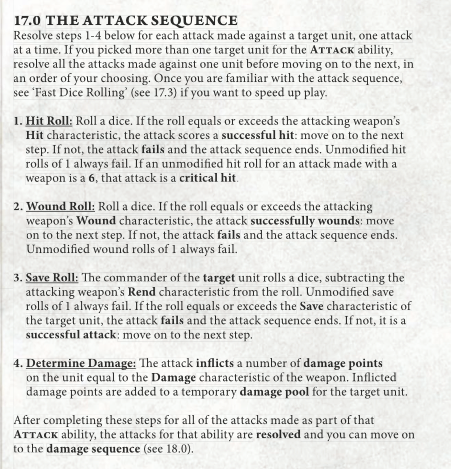
Stas pasted fragments of the rules into chat and got stuck on the order of operations:
- first, you resolve all attacks made as part of that Attack ability
- only after that do you move on to the damage sequence and allocate damage points
And that immediately raised the suspicious question:
If damage only gets allocated after all attacks are resolved, does that mean excess damage from each successful attack doesn’t spill over model by model in the way we intuitively expect?
In other words: if one attack deals 3 or 4 damage into a 1-wound model, does that still only slay one model? And if so, how many models can a unit actually kill?
Our first instinct
Michał’s immediate read was the practical one, and honestly probably the one most players naturally arrive at:
- if a model has Attack characteristic 5, then it makes 5 attacks
- those are still 5 separate attacks, not 5 separate Attack abilities
- so that model can potentially kill up to 5 models, even if each successful attack has Damage 3
- but it does not somehow turn into killing 15 one-wound models just because the raw damage number is 15
That feels intuitive, and it also matches how a lot of people have played similar interactions for years.
End3r put it in a nice compact way too: a big pile of attacks might kill up to the number of successful attacks, but not multiply into absurd overkill from each damage point spilling across the whole unit.
Where the confusion came from
The confusing bit was the wording around:
- resolving steps 1-4 for each attack
- adding damage points to a temporary pool
- then only after all attacks are done, moving to the damage sequence
That wording can absolutely make your brain go in two different directions.
One reading is the “normal” one:
- Make attacks one at a time.
- Each successful attack generates damage.
- That damage is then allocated in a way that still preserves the idea that one attack can only slay so much.
The other reading is the terrifying rules-lawyer version Stas wrote out as pseudo-code:
dmg_pool = 0
for attack in attacks:
    if hit and wound and not save:
        dmg_pool += attack.dmg
while dmg_pool > 0:
    unit.models[0].health -= 1
    if unit.models[0].health == 0:
        slay(unit.models[0])
        dmg_pool = 0
And yes, as Stas immediately pointed out, that would be nonsense.
Because under that interpretation, a huge elite unit with loads of high-damage attacks could theoretically crash into a screen of 1-wound models and kill… basically one model, because the pool would get wiped when the first model dies.
That clearly doesn’t pass the common-sense test.
The example that broke our brains
Michał threw out a deliberately silly but very useful example:
- a big unit of Chosen
- loads of attacks
- each attack dealing 4 damage
- target: a unit of 1-wound models
If we followed the most literal, broken reading, then all that incoming damage would somehow only matter for slaying a single model. Which is obviously absurd.
So the discussion quickly became less about “what would be sensible” and more about “how do we reconcile the wording with how the game clearly has to function?”
Where we landed during the discussion
At the chat stage, our working understanding looked like this:
- Attack characteristic gives you a number of attacks, not separate Attack abilities.
- You resolve those attacks one by one as attacks.
- A successful attack with Damage 3 can still only meaningfully slay one 1-wound model, unless some other rule changes that.
- So if you have 5 successful attacks, you can kill up to 5 one-wound models, not 15.
- Likewise, a massive unit making 40 successful attacks into 1-wound infantry can kill up to 40 models, not 160.
That was the practical conclusion from the conversation.
Why this matters at the table
This is one of those rules interactions that is easy to gloss over because most of us learn the flow of the game by playing, not by reading every paragraph like legal text.
But if your group has even slightly different assumptions about:
- when damage is pooled,
- when it is allocated,
- and whether excess damage from a single attack spills into more models,
then suddenly the same combat can have wildly different outcomes.
And that’s exactly the kind of thing worth settling before dice hit the table.
Our hobby-tip takeaway
If a rule passage makes you stop and say “wait, what?”, do three things:
- Separate the terms carefully — attack, Attack ability, damage points, allocation.
- Test the reading with an absurd example — if 40 giant axe swings can only kill one Clanrat, something has gone wrong.
- Write it out step by step — even goofy pseudo-code can help expose where an interpretation breaks down.
Honestly, that last one is underrated. The moment Stas wrote out the damage-pool logic, the problem became much easier to see.
The screenshot that kicked it off
Here’s the image Stas dropped into chat during the discussion:
Final thought
We’re big fans of rules discussions like this, not because we enjoy arguing for the sake of it, but because this is part of the hobby too. Sometimes painting is the relaxing bit, and the real battle is fought in a PDF with badly copied text from the core rules.
Also, bonus points for the most relatable ending possible: after dropping a pseudo-code rules paradox into chat, Stas just went to walk the dog.
If you’ve had a similar Age of Sigmar rules headache, we’re always happy to hear how your group handled it.