Can You Reform and Still Shoot in The Old World? A Quick Rules Lesson
We had one of those very familiar The Old World moments recently: a simple question turned into a mini rules dive, a side discussion about Chaos Dwarfs, and then a brief reality check on how much we still have to learn.
The starting point was wonderfully practical:
can I reform and then shoot?
And honestly, that is exactly the kind of question that comes up in real games. Not abstract theoryhammer, but the kind of thing you ask when something nasty appears in the wrong place and you need to know whether your unit can still do its job.
The short answer
Yes — a unit can Reform and then shoot.
The catch is that reforming counts as movement, so the unit suffers the usual -1 To Hit penalty for Moving and Shooting.
That was the key clarification in our chat. At first there was that classic moment of doubt:
- does a normal reform block shooting?
- is this what some special reform rule is for?
- are we mixing up standard Reform with something else?
But the core takeaway was simple: a normal Reform is still a movement manoeuvre, not a prohibition on shooting.
Why this matters on the table
The example that immediately clicked for us was this: if something pops up behind your line — in our chat it was Goblin sneaky nonsense threatening the rear — then in principle you can:
- Reform up to 180°
- turn to face the threat
- shoot at -1 because the unit moved
That is a really useful little rules interaction to remember, especially for armies that want to keep firing lanes open but also hate being out-positioned.
So what was the confusion?
Part of it came from that very normal feeling of:
why does some “special” reform exist if regular reform already lets me turn and still shoot?
And honestly, fair question.
In the conversation, we also touched on the fact that some units have access to other movement tricks, including various free reforms or post-move repositioning. That is usually where the mental wires get crossed: standard Reform, free reform, and whatever special movement rule a given troop type has are not automatically the same thing.
So the hobby tip here is not just the answer itself, but the method:
Hobby tip: separate the questions
When a movement rule gets confusing, it helps to split it into three parts:
1. What kind of move is this?
Is it a normal manoeuvre, a special move, a free reposition, or something tied to another rule?
2. Does it count as movement for shooting?
In this case: yes, so you take the -1 To Hit.
3. Does the rule itself forbid shooting afterward?
For a normal Reform, the answer here is no.
That sounds obvious written out like this, but at the table it saves a lot of rulebook flipping.
The second lesson: AI rules help is useful… until it isn’t
This chat also drifted into another very 2026 hobby topic: using AI to check rules quickly.
On the plus side, it gave a neat, concise answer about Reform and shooting, including a citation for Moving and Shooting. That part lined up nicely with what we needed.
But then things got fuzzier when the discussion moved toward Swift Reform, special cases, and the timing of units arriving from reserve/ambush. At that point the answers started looking a bit more like educated guessing than reliable rules support.
And that is probably the real hobby tip here.
Our takeaway
AI can be great for:
- finding the relevant section faster
- confirming a straightforward interaction
- pointing you toward the right page or rule heading
But it is much less trustworthy when:
- the wording is very specific
- the rule name may be misremembered
- the interaction depends on exact phase timing
- the answer starts sounding confident without really proving anything
In other words: good assistant, not yet a TO.
Timing still matters more than the clever answer
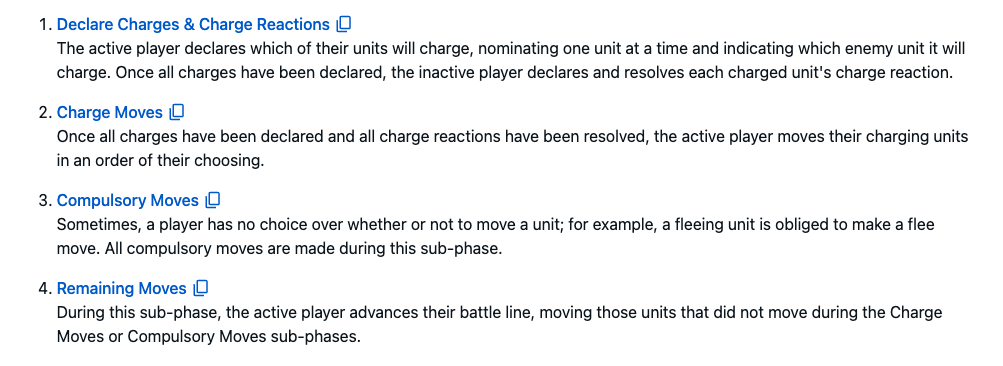
The follow-up example in our chat was whether rear-appearing troublemakers could charge immediately. That is where phase order became more important than the original reform question.
And that is another good reminder: even if your unit can reform and shoot, the real question in-game is often whether the enemy gets to do something first.
Sometimes the answer is not “can I do this?” but “will I still have the chance?”
Final answer for the notebook
If you want the quick version to remember for your next game of Warhammer: The Old World:
Yes, you can Reform and then shoot. Reform counts as movement, so you suffer -1 To Hit for Moving and Shooting.
Simple, useful, and exactly the kind of thing we keep forgetting until it matters.

As always, half the fun of The Old World is discovering that the answer is either much simpler than we feared, or hidden three steps deeper in the sequence than we expected.
And yes, we absolutely sympathise with the feeling of “I do not understand all these rules at all”. We have all been there.