General Challenges in The Old World: Small Rule, Big Consequences
We had one of those classic league-chat moments recently: someone asked a seemingly simple rules question, and five minutes later we were deep in one of the most important little tactical layers in Warhammer: The Old World.
The topic was general and champion challenges. At first glance it sounds straightforward — just a cinematic 1v1 inside a bigger combat. But the more we talked it through, the more obvious it became that this is one of those rules that can completely change how you evaluate charges, unit upgrades, and even whether a monster character should go into a cheap infantry block at all.
So, are challenges part of our league rules?
Yes — but only because they are already part of the core The Old World rules. We are not using some extra house-rule version here.
As Stas pointed out, we honestly don’t use them often enough in our regular games, which is probably a mistake. On tournaments, like Dragon, people do use them regularly, so it’s worth getting comfortable with them before they catch us off guard at the table.
What is a challenge, in practice?
In simple terms, it is a duel between characters — and sometimes even between a character and a unit champion.
The defending unit’s character or champion can issue a challenge, and that creates some very real tactical choices.
Usually, you do it for one of two reasons:
- to try to kill an enemy character,
- or to soak up that character’s terrifying attacks with one relatively cheap model.
And that second use is where things get really funny.
The classic example: the 7-point champion versus a Wyvern boss
Stas gave a perfect example: imagine a Warboss on Wyvern charging into your unit. Normally, that is terrifying. A pile of strong attacks can mulch rank-and-file models and swing combat hard.
But if your little unit champion steps forward and issues or accepts a challenge, suddenly all those attacks have to go into that one poor guy.
So yes, the champion probably gets absolutely obliterated.
But instead of losing a whole bunch of regular troops, you may lose only one model. For a tiny points investment, that can be an incredible trade.
That alone already makes champions feel much more valuable than they first appear.
Overkill matters
Of course, it is not completely free.
Extra wounds caused in a challenge can count toward combat resolution as overkill, up to a limit. So sacrificing a champion is often good, but it is not always enough to fully blunt the impact of a monster character.
That was the first important reminder from the discussion: challenges are not just flavor. They directly feed into combat maths.
The really spicy bit: mounts and initiative order
Then the conversation reached the part that made all of us stop for a second.
Michał brought up a tournament ruling from Dragon: if one part of the mounted model kills the challenged opponent first, then attacks from the other part at a lower Initiative can simply be lost.
That sounds brutal, but Stas dug out the relevant rule text:
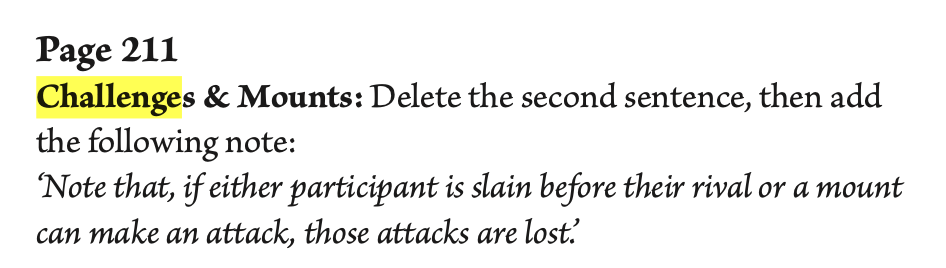
Challenges & Mounts
If either participant in a challenge is mounted, their mount (including the crew of a chariot) must direct its attacks against the other participant. Note that, if either participant is slain before their rival or a mount can make an attack, those attacks are lost.
That means the exact order of attacks matters a lot.
If the mount attacks first and kills the enemy champion, the rider’s attacks can disappear before they ever happen. And vice versa.
This is one of those wonderfully mean Warhammer details that turns a “my giant monster will obviously crush this” situation into “wait, did I just charge into a trap?”
Why this changes real decisions on the table
This is where the discussion got especially interesting for us, because it stopped being about raw rules knowledge and became a question of practical gameplay.
Michał pointed out a great example: is it actually worth charging a Wyvern into some dirt-cheap infantry block?
If that unit has a champion, the challenge can force your expensive combat character to waste attacks into a single model. If the kill happens in the wrong Initiative step, some of your attacks may be lost entirely. Suddenly your huge charge does very little damage, while the infantry block still brings static combat resolution.
And in The Old World, cheap infantry can stack a surprising amount of that.
We were talking specifically about blocks benefiting from things like:
- Horde
- Warband
- Close Order
- Massed Infantry
That kind of unit can begin combat with a very healthy pile of combat resolution before rolling many dice at all. So if your monster character only gets a single challenge kill, that may simply not be enough.
The flank charge angle
Then came another important wrinkle: positioning.
A front charge into a big infantry block is one thing. But if the Wyvern gets into the flank or rear and disrupts ranks, the equation changes dramatically. Suddenly that infantry unit may lose some of the static combat resolution that made the challenge trap so effective in the first place.
That is exactly why these interactions are so cool: the challenge rule does not live in isolation. It connects to movement, charge angles, formation rules, command upgrades, and combat resolution.
So yes, a champion can save the unit.
But also yes, a properly lined-up monster charge can still dismantle the whole plan.
Why full command keeps looking better and better
One of the funniest conclusions from the chat was basically this: every time we dig deeper into The Old World, full command starts looking more and more justified.
A champion is not just a decorative extra attack.
He can:
- protect the unit from an enemy blender character,
- force awkward challenge interactions,
- manipulate how damage gets allocated,
- and buy time for your static combat resolution to do the heavy lifting.
That is a lot of utility from a model we often treat as an afterthought.
A very Warhammer kind of rule
What we love here is that this is exactly the sort of design that makes old-school Warhammer combat so engaging. Tiny wording details create genuinely strategic choices. A cheap champion can alter the outcome of a fight involving a giant monster. Initiative order can matter more than raw damage output. A “bad” target can become a trap.
And yes, as Michał noted at the end, there is something very familiar in seeing how many of these systems are built around layers of interactions rather than one obvious answer.
Our takeaway
After this conversation, our big takeaway is simple:
we should be using challenges more often in our practice games.
Not just because they are in the rules, and not just because tournament players use them, but because they are clearly one of the mechanics that reward experience. The more we understand them, the better we will evaluate charges, champions, and monster characters.
So if you are also learning or re-learning Warhammer: The Old World, this is a great little hobby-tip from the battlefield side of the hobby:
- don’t ignore champions,
- don’t assume your monster character always wants to charge cheap infantry,
- and always check Initiative order when mounts are involved.
Sometimes the most important model in the fight is not the dragon, not the warboss, but a tiny unit champion whose entire job is to die at exactly the right moment.