Our Old World campaign is taking shape: 750-point starts, hero upgrades, and Cathay loot dreams
We’ve been ironing out the shape of our upcoming Warhammer: The Old World campaign, and this was one of those very fun hobby conversations where practical list-building, campaign rules, painting panic, and wild narrative ideas all collided at once.
The current plan is to start at 750 points and then grow armies in 300-point increments. That feels like a really nice pace to us: small enough to get games in quickly, but with enough room for armies to actually evolve instead of jumping straight from “tiny patrol” to “full-size war”.
For scenario structure, Michał proposed a clean split:
- below 1000 points: Battle March
- above 1000 points: Grand Melee + Combined Arms
That gives the campaign a nice sense of escalation. Early on, lists stay tighter and more constrained; later, they open up into something that looks and feels much more like a full Old World battle.
Hero continuity and campaign growth
A big part of the discussion was how we want heroes to persist through the campaign.
Stas asked the exact kind of question that immediately makes a campaign more interesting: if a character starts as, say, an Orc Bigboss, can he later become an Orc Warboss? And if he starts as a Black Orc Bigboss, can he eventually upgrade into a Black Orc Warboss?
Michał checked the Compendium and found the mechanical baseline: to upgrade a hero, you pay the difference in points. That’s a very elegant starting point.
From there, the more important bit for us was the narrative ruling: we’re allowing pretty broad character modification as long as it’s supported by the story. So an orc becoming a bigger, meaner orc? Absolutely. A Skaven Master Assassin somehow turning into a Grey Seer? Probably not.
We really like that approach. It keeps the campaign flexible without losing the feeling that characters belong to the world.
Michał also floated a practical campaign interpretation that we may use when needed: if you “buy” the upgraded version, then mechanically you may now have both profiles available in your wider force structure — with the older one perhaps staying behind, leading another banner, or defending a settlement. That’s still being refined, but we love the direction.
Maybe we sneak a skirmish game into the campaign?
Another idea we got excited about was weaving some kind of small-scale skirmish into the Old World campaign.
Not necessarily a full separate game system right away, but maybe something more RPG-flavoured: take our main heroes, turn them into a little band, and send them against an “AI” force or some campaign-driven scenario. That sounds extremely fun, and exactly the sort of thing that makes a campaign memorable beyond just tracking wins and losses.
We don’t have the full rules framework for that yet, but it’s very much on the table.
Stas has chosen the path of the horde
Stas landed on a 750-point starting list for the campaign, loosely inspired by the style of the list he used in Cinquecento.
The key takeaway?
Horde.
The second key takeaway?
82 models to paint.
So naturally, the reaction was the only correct one: ha-ha.
To be fair, Michał immediately answered with the kind of hobby plan that sounds suspiciously achievable when written in a chat window:
- one day for prime + zenithal
- second day for skin on everything
- third day for metal
- Thursday for extras
- next week for details
Honestly, we respect the optimism. Also, this is exactly the sort of momentum a campaign can create — suddenly a terrifying pile of models becomes a sequence of manageable steps.
Mid-week test game at 1500 points
While campaign planning was happening, Wilini and Michał were already lining up a 1500-point test game for Wednesday. That gave us two very concrete examples of where the campaign might eventually go once we move past the opening 750-point stage.
Wilini’s Bretonnia at 1500
Wilini shared a Kingdom of Bretonnia list for Grand Melee + Combined Arms, built around a strong mounted core, support magic, peasants, and Pegasus Knights.
What we like here is that it feels very Bretonnian in the best possible way: a proper noble striking force, but still grounded by infantry and bowmen instead of going full tunnel vision on cavalry only.
The list was created in our builder, which we’re obviously very happy to keep seeing in actual use.
Michał’s Skaven at 1500
On the other side of the table: absolute rat nonsense.
Michał brought a Skaven Renegade 2.0 list with a Grey Seer, two Warlock Engineers, Clanrats with weapon teams, Giant Rats, Globadiers, a Hell Pit Abomination, and a Warp Lightning Cannon.
So yes, this has all the ingredients for a perfectly reasonable game of Warhammer: The Old World, by which we mean magic, unstable technology, horrifying monsters, and the very real chance that something explodes for reasons nobody fully understands.
Again, same tool, same shameless satisfaction:
Tiny rules questions that always matter later
We also had one of those classic campaign-prep rules checks that seem small until they suddenly decide a game.
Michał asked whether the Battle Standard Bearer has a special command range, or just uses Leadership. Stas dug up the answer: it’s 12 inches, like the General, and 18 inches if mounted on a Large Target, regardless of the BSB’s own Leadership.
That’s exactly the sort of thing it’s better to clarify now rather than halfway through a key combat.
It also triggered a little flashback to an earlier game where we apparently handled a squig-banner situation less generously than the rules actually allow. As always: every campaign is also a journey of discovering what we’ve been accidentally doing wrong.
Cathay caravan loot: now this is campaign design
And then the conversation took a turn we absolutely want more of.
Michał had the idea that in the campaign, destroying a Cathay caravan could grant the winner a Cathayan magic item worth up to 75 points for use in their own army.
This is such a good campaign hook. It’s thematic, it creates a concrete objective, and it introduces weird cross-faction treasure in a way that feels like a proper story reward rather than just a spreadsheet bonus.
The best part is that once Michał started looking through the Cathay magic items, the reaction quickly became: there are loads of them, and basically all of them are cool.
So of course we now have a gallery of tempting loot to stare at and scheme over.
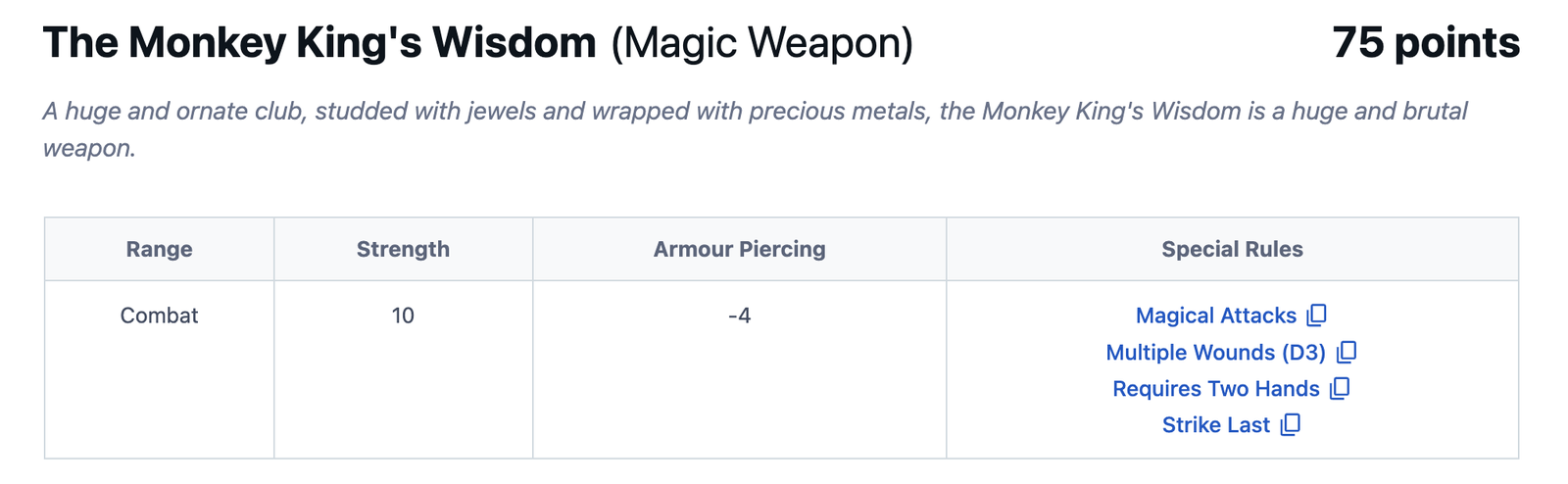
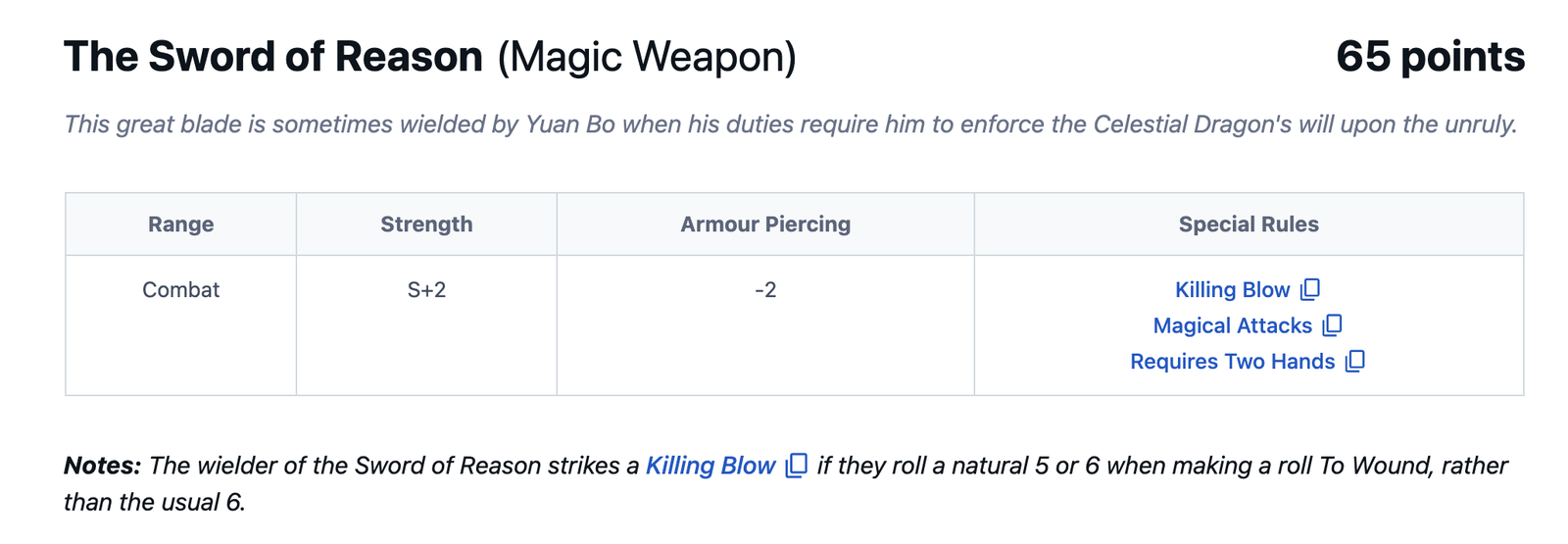
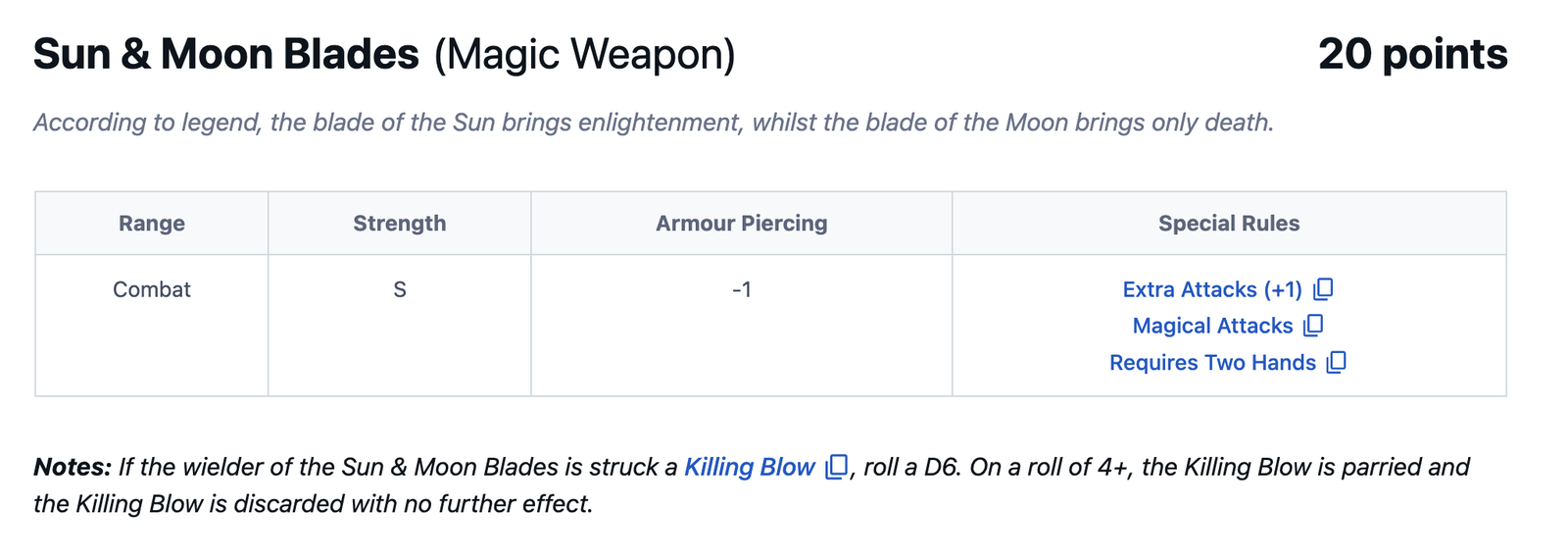






Even without finalising the exact reward table yet, this already feels like the kind of campaign content we want to build around: specific, characterful, and just a little bit unhinged.
Where we are now
So at this point, the campaign picture looks something like this:
- start at 750 points
- increase by 300 points
- use Battle March below 1000 points
- switch to Grand Melee + Combined Arms above 1000
- allow hero progression by paying the points difference
- permit broader character evolution if it makes narrative sense
- possibly add a skirmish / RPG-style side layer
- definitely keep thinking about scenario rewards, especially weird treasure
Honestly, this is exactly the stage of campaign prep we love most. Nothing is fully locked yet, but the shape is there, the armies are emerging, and every new question makes the whole thing feel more alive.
Now we just need to do the easy part: paint everything, write the campaign rules, and decide who gets to loot Cathay first.